
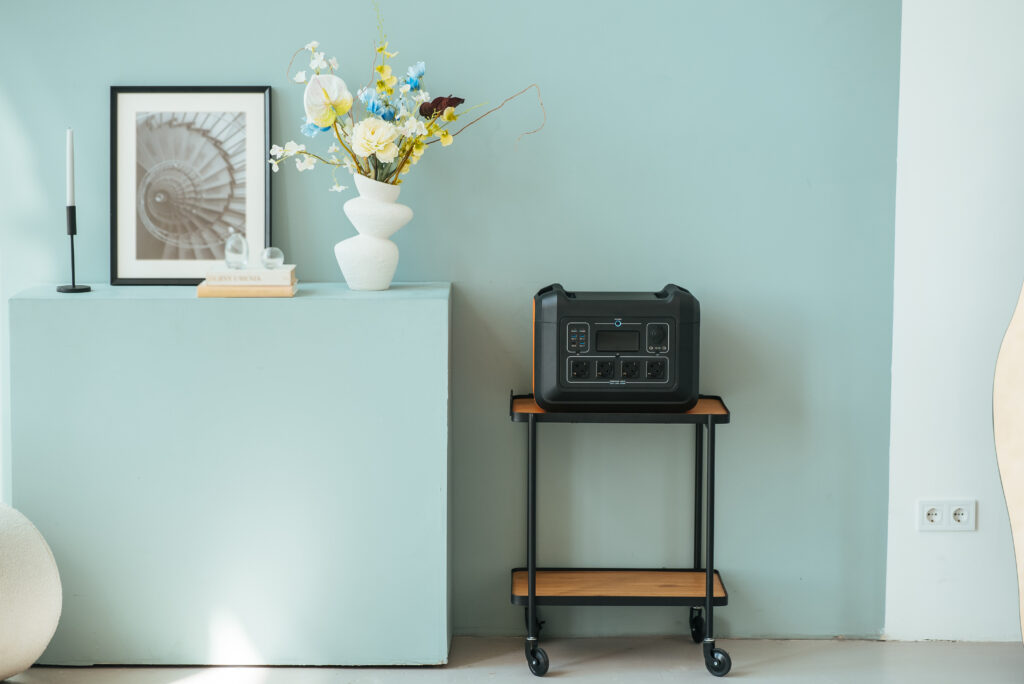
The rest of the field in this tier clusters between 200 and 294 Wh. The Anker 535 PowerHouse sits at 512 Wh — roughly double the next-best option — and pairs that with a 500 W rated inverter that’s also the highest output ceiling here. For a buyer whose only real constraint is the $300 limit, nothing else is close.
What makes 512 Wh real rather than theoretical is what the LiFePO4 pack held up to over extended use — across more than 50 cycles, independent testing found no measurable capacity loss, and the reinforced case survived repeated drops without complaint. The cooling fans land around 30 dB, quiet enough to ignore from a few feet away. For a unit that might sit between trips, self-discharge runs only about 2–3% per month, so it’s genuinely ready when you pull it out of storage — a detail that matters more than it sounds for buyers who grab the unit twice a year in an emergency.
At roughly $0.59 per watt-hour, the 535 ties the AC2P for the best value in the tier, while delivering more than twice the absolute capacity and the highest output ceiling of any unit under $300. The next-largest option here tops out around 294 Wh; there is no close alternative on the axis this segment is decided by.
There are two limits to respect before plugging in. The 500 W ceiling is a real one — anything with a heating element will hit it, and testing confirmed a 659 W hair dryer caused an immediate shutdown. And a small fraction of grounded three-prong cords won’t seat cleanly in the outlets. Neither of these touches the camp and electronics loads this segment is built for — a 60 W mini-fridge, a 55-inch TV, a CPAP, or a full family’s phones and tablets across a 24-hour stretch — but they would matter to an appliance buyer, who should look elsewhere.
One honest caveat on the spec figures: weight, recharge time, solar input, and switchover data for the 535 come from review-derived measurements rather than manufacturer spec sheets. The numbers above — ≈16.5 lb, ≈2.5 h to 80%, ≈120 W solar ceiling — carry slightly less certainty than a catalog spec. Treat them as solid planning figures, not guarantees.
Skip it if: you need to run anything with a heating element or a motor, or if you want a unit light enough to carry on a hike — at ≈16.5 lb this is a vehicle-hauled or stationary station, and the ultralight segment is the right place to look.
Four units in this tier can switch to battery in 20 milliseconds or less — fast enough that a router or modem never sees the outage. On paper it’s nearly a four-way tie. What breaks it isn’t specs; it’s what each unit does after weeks of continuous use, which is exactly the condition this job requires.
The RIVER 3’s switchover has been independently confirmed to hold across modems, routers, switches, and sensitive gear without a single device reboot — which is the whole job in one sentence. Its GaN inverter idles at about 5 watts, roughly half what its predecessor drew, and that difference is what stretches a 70-watt networking stack from well under three hours to comfortably over it. At 30 dB, owners run it in a bedroom and can’t hear it. And after extended continuous use, no drain or lockout pattern has emerged — the failure mode that disqualifies two of its rivals simply isn’t there.
A full-discharge test pulled approximately 213 Wh from the 245 Wh nameplate, about 86%, at a steady 20-watt workstation load that ran 5–9 hours. A 70-watt router-modem-switch stack estimates 3-plus hours of ride-through at that efficiency. For a unit whose job is bridging outages rather than camping for a weekend, that’s the number that counts.
One setup step before leaving it unattended: the RIVER 3 doesn’t filter power-line surges on its own. Run a surge protector between the wall outlet and the RIVER 3, not between the RIVER 3 and your gear, and that’s fully resolved.
Here’s why the closest rivals don’t take this segment:
The C300 is faster on paper (10 ms), quieter (25 dB, confirmed as clean pure-sine output), and the runner-up for anyone running loads through the AC outlets. But it carries two flaws that bite continuous UPS use specifically: its USB-C output ports auto-shut off after roughly two hours at low current, which means a router or Raspberry Pi running on USB-C silently dies mid-shift, and its inverter idles at around 12 watts — more than double the RIVER 3. Choose the C300 over the RIVER 3 only if silence is the priority and every device runs off an AC outlet, not USB-C. Note that at $300 it sits exactly at the price ceiling.
The Bluetti AC2A is disqualified for shelf standby by a recurring BMS lockout that can brick a unit stored at low charge, with no documented recovery path from the manufacturer. Fine as a plugged-in cycling unit, but when the pick for this segment needs to carry zero such risk, there’s no reason to accept it. The EcoFlow RIVER 2 is ruled out by a parasitic drain of 5–25% per day — it empties itself in about a week unplugged — plus a slower switchover (30 ms) and a louder fan (53–54 dB) than the RIVER 3, at only $10 less.
Skip it if: your UPS load runs through USB-C ports rather than AC outlets — the C300’s auto-shutoff makes it the wrong choice there, but the RIVER 3 handles it cleanly — or if you need more than 3 hours of ride-through on a heavy networking stack, in which case the Biggest Battery segment has more capacity to work with.
Airline rules make the decision before weight or capacity get a vote. The FAA’s carry-on band runs from 100 to 160 Wh, and most major carriers allow up to two units in that range with prior approval. Of every unit in this tier, exactly one clears that gate.
At 3.97 lb and 128 Wh, the Elite 10 is the only unit here that flies, and it’s half the weight of everything else on this page. It pockets into a coat or drops into a daypack without a second thought. That’s the whole case, and it doesn’t need a longer argument — nothing else comes close on either dimension.
Beyond the flight clearance, it’s a capable travel charger. Independent testing confirms a 10 ms UPS switchover, and the Turbo recharge mode fills it in roughly 70 minutes. Real usable capacity runs to around 100 Wh at higher draw, climbing to the high-80s percent of the 128 Wh nameplate at moderate 60–100 W loads — right-sized for a travel charger running phones, tablets, cameras, and a laptop across a travel day. A 14-watt modem runs about 5 hours; a low-draw CPAP gets around 8; five to ten phone charges per fill is a reasonable expectation.
Two limits matter before you pack it. The 100 W USB-C port doesn’t reliably sustain full rated output under sustained high-draw devices — a Starlink Mini rebooted cyclically on it during testing. If your kit includes a high-draw laptop or Starlink over USB-C, verify compatibility before you depend on it. The 200 W AC ceiling is also a hard wall; there’s no headroom above it. Warranty here is 3 years, shorter than the 5-year coverage most of this tier offers.
If you’re not flying, the picture shifts. The Bluetti AC2P at $129 is heavier at 7.9 lb — no carry-on advantage — but delivers 230 Wh at the best per-watt-hour value in the entire tier, with a fast Turbo recharge and a strong record for device charging. As a bag-carried ground charger that gets used regularly rather than stored, its storage-lockout risk matters less; for that use case, see its full treatment in the all-rounder segment below.
Skip it if: you’re not flying and weight isn’t a hard constraint — the all-rounder segment will get you nearly twice the capacity for less money, with better long-term reliability.
The 300-watt-class LiFePO4 stations in this tier — five units, 205 to 294 Wh, all rated 300 W — are close enough on specs that picking among them on numbers alone is the wrong exercise. What separates them is what the reviews show after months of real use, especially for a unit that will spend time on a shelf between camping trips.
The 300 v2 is the only unit in this segment whose review verdict lands as an unqualified strong buy, and the reason is the one thing a years-of-use buyer actually needs: its LiFePO4 cells are rated to 4,000-plus cycles — roughly a third more than the 3,000-cycle norm across the rest of the tier — backed by a 5-year warranty and built into the lightest body Jackery makes at 8.16 lb. Switchover checks in at 20 ms and a full recharge takes about 1.27 hours.
What tips a near-tie into a clear verdict is a cross-brand signal: the EcoFlow RIVER 2‘s own review specifically steers shelf-backup buyers toward the Jackery 300 v2, citing owner reports of far better charge retention in storage. When a competing product’s review is pointing buyers at your pick, that’s the kind of evidence worth trusting.
In practice, 288 Wh covers a campsite’s devices across a weekend without anxiety — roughly 3.7 hours on a 65-watt laptop, 8–12 full charges for cameras and drones drawing around 25 watts, and well over two dozen phone charges per fill. A 60–80 W mini-fridge gets 3–4 hours, which is a day-trip cooler load but not an overnight one — a limit of the whole 300 Wh class, not this unit specifically.
A certainty note worth carrying: most of the 300 v2’s performance figures — the 4,000-cycle life, the roughly one-hour 80% recharge, the UPS spec — come from manufacturer claims and spec-based analysis rather than independent bench measurements of this exact unit. They’re consistent with what LiFePO4 chemistry delivers at this scale, but the confidence level sits a notch below units with independently confirmed numbers.
Skip it if: budget is the only filter and you’ll use it constantly rather than store it — the AC2P saves $140 and performs well when it’s kept in regular rotation; or if you need to fly with it, in which case only the Elite 10 clears airline rules.
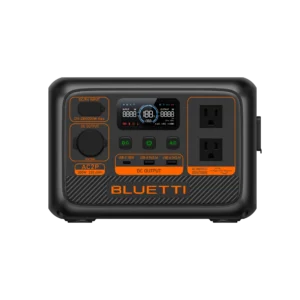
The pure-value argument: 230 Wh at $129 is the best dollars-per-watt-hour in the entire tier, the Turbo recharge is genuinely fast, and a full day of small electronics use ends with 20–25% battery remaining. It’s the runner-up rather than the pick because of one recurring failure pattern documented in owner reports: an E113/E116 lockout after idle storage or a grid event, requiring troubleshooting before the unit works again. For a trust-it-for-years all-rounder, that’s the one thing you can’t accept — which is also why the Jackery’s storage reliability is the deciding factor, not the capacity delta or the price gap.
If you buy the AC2P, buy from a retailer with a clear return path and keep it cycling rather than in storage. As a frequently-used travel charger (its role in the Ultralight segment), that same lockout risk is much less likely to surface; the difference is how often the unit sits idle.