
When you purchase through links on our site, we may earn an affiliate commission. Learn more.
Home backup means different things to different households. A CPAP user needs something near-silent that switches over the instant the grid blinks and keeps running all night — a very different machine from what a condo renter needs to keep a fridge cold through a ten-hour outage, or what a rural homeowner needs to run a well pump and central AC for two days after a hurricane. EcoFlow makes a unit for each of those situations. The mistake is picking by price or battery size without first asking which problem you’re actually solving.
Two things shape this guide that a camping or travel page wouldn’t touch. Split-phase 240V output is a hard line: only a handful of EcoFlow units can run a well pump, electric dryer, or central AC, and every unit that can’t is excluded from the whole-home segment regardless of how large or capable it looks on a spec sheet. And the DELTA Pro Ultra line — EcoFlow’s home-battery-backup hardware — earns full coverage here because whole-home standby is exactly the job it was built for.
The picks below are organized by buyer situation, not by price or prestige. Use the router to find your row, then read only that segment — the right unit for your neighbor’s house may be the wrong one for yours.
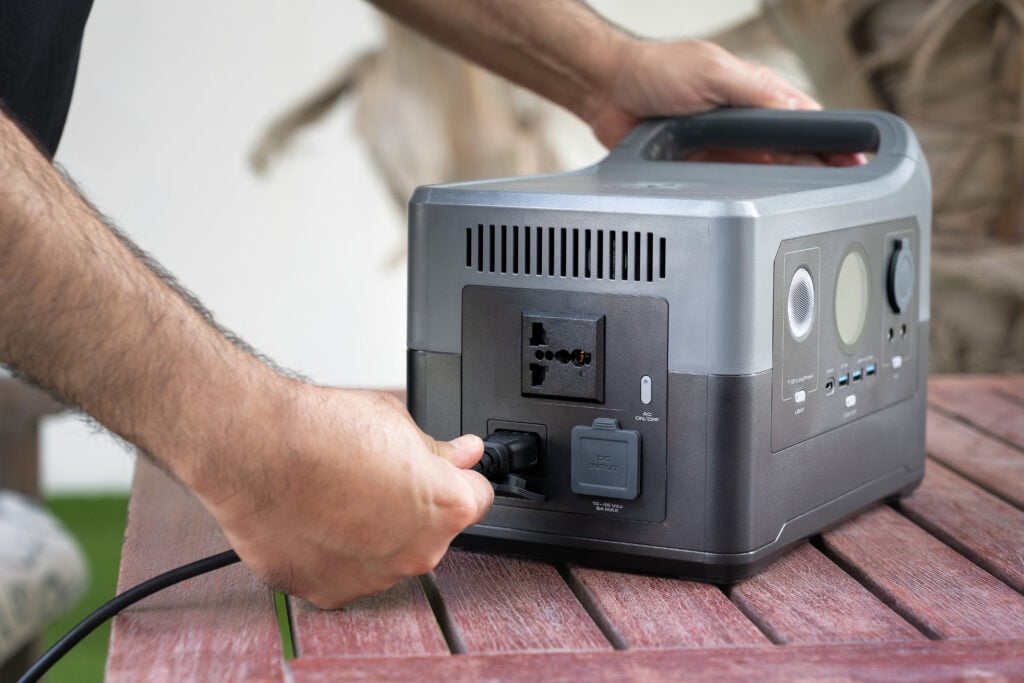
For this buyer, the spec that decides everything isn’t watt-hours — it’s whether the unit is quiet enough to sleep next to and switches over fast enough that the device never sees a power interruption. Everything else is secondary.
It delivers two-plus nights on a single charge at a CPAP’s moderate-pressure draw — owner reports confirm the runtime through real overnight outages, and the fan is quiet enough that people sleeping a couple of feet away don’t notice it even when the unit is under load. The sub-10ms switchover means the machine never reboots when the grid drops; because this unit lives plugged into the wall rather than feeding off solar, the firmware bug that affects solar charging is irrelevant here. LiFePO4 chemistry rated for roughly 3,000 cycles to 80% gives it a decade-class standby life, which a conventional medical UPS with lead-acid chemistry can’t match.
One real limit: if your CPAP uses heated humidification or runs at high pressure, the draw climbs and the 286Wh base may not reach two nights reliably — see the runner-up below.
One brand-wide caution that applies here above anywhere else on this page: EcoFlow’s warranty and support process — slow, ticket-based, return-first — is flagged consistently across owner accounts. For a device someone’s health depends on, that gap matters more than any spec. Keep an independent fallback — a second battery, a traditional medical UPS, or a different backup path — register the warranty immediately, and verify the unit performs correctly on arrival. This isn’t specific to the RIVER 3 Plus; it’s a pattern across the EcoFlow line that you must plan around before committing to it as your sole medical backup.
Note: the picks in this segment are about equipment runtime, not medical guidance. Anyone relying on a CPAP or oxygen device for health should confirm their backup plan with their care provider.
Skip it if: Your CPAP uses a heated humidifier or high-pressure setting — the DELTA 3‘s larger tank and 12V DC output option handle that load with several nights of margin.
for a humidified or high-pressure machine, or if you want multi-night margin without recharging. At roughly 900Wh usable at the CPAP regime and with a 12V DC port that bypasses inverter idle entirely, it stretches runtime further than the RIVER 3 Plus can. It’s quiet at 30dB and switches over in under 10ms. The cost is 17 extra pounds and a larger footprint on the nightstand. The same support-fallback caution applies — the hardware suits CPAP duty, but keep a backup plan for anything you depend on medically.
When a generator is off the table — HOA rules, fire codes, no outdoor space — the question becomes: which single box keeps the fridge cold, the router online, the lights on, and the devices charged through an overnight outage, running quietly in a living space?
The DELTA 3 Max is the unit EcoFlow built for exactly this buyer — owners under HOA and fire-code restrictions who have no viable generator alternative name it as the choice, and the pattern holds across owner accounts. At roughly 1.85kWh usable at a fridge-plus-electronics load, it covers a full overnight outage with margin: the fridge cycles through the night, the router stays up, the lights stay on, and devices come into the morning charged. At 25dB it runs unobtrusively in a living space — quieter than the base DELTA 3 and the DELTA 3 Plus at comparable loads, which matters when the unit is in the same room as the people it’s serving.
The switchover is proven, not just spec-sheet: one owner documented it preventing two server crashes over a year of daily use, with connected equipment riding through grid events without rebooting.
Two limits to know before you buy. First, it is not expandable — 2,048Wh is the permanent ceiling, and some owners have been surprised by that after purchase. If you think you might want more runtime later, the base DELTA 3 (which expands to 5kWh) is the right call instead. Second, its single 500W solar port means a full recharge from solar takes four-plus hours — this is a wall-fed unit, which is exactly what an apartment backup needs to be, but don’t plan a solar strategy around it.
Skip it if: You want an expansion path for longer outages or a tighter budget — the base DELTA 3 covers shorter outages at lower cost and grows with you.
a strong all-rounder at a lower price, and the right pick if your outages are shorter, your budget is tighter, or you want to add runtime later. At roughly 930Wh usable it covers a fridge and router for around eight hours, it’s quiet at 30dB, switches over in under 10ms, and expands to 5kWh with an add-on battery. Two things to plan around: EcoFlow’s warranty support runs slow across the line, so register early and keep your receipt; and a documented shutoff at sustained sensitive loads (one owner’s 3D printer at 375W tripped the AC outlet) means you should treat the rated output as a ceiling under sustained draw rather than a guarantee.
the right choice for a router, NAS, or Starlink that needs an always-on UPS at the lowest price in this line. Its 10ms switchover and a class-leading 13W idle make it a credible always-on standby for sensitive electronics. Two catches limit it to this narrower role: a default 2-hour auto-shutoff that must be changed to ‘never’ before you connect a cycling fridge, and a documented BMS MOSFET failure mode under high-cycle daily-outage use, with warranty-decline reports attached to it. For occasional outages and electronics backup it’s a strong budget buy; for a household cycling it hard every day, that reliability tail is the reason it sits behind the Max and the base DELTA 3.
A note on the DELTA 3 Plus: Its own review is direct — pass on it if your plan is a continuously-on, set-and-forget home backup. It idles at roughly 32–40W (versus the base DELTA 3’s ~17.6W and the Classic’s 13W), its time-of-use scheduling is unreliable, and the fan cycles erratically under the exact conditions a home-backup unit faces: plugged in, waiting, running light loads indefinitely. Its standout feature is dual 1,000W solar, which a wall-fed apartment unit never uses. For this job, the base DELTA 3 or the Max is the better-matched buy.
Storm country demands more than overnight coverage. When outages run two or three days, the job is sustained 120V output across many circuits — fridge, freezer, lights, fans, intermittent kitchen appliances — with room to add runtime as the situation demands.
The DELTA 3 Max Plus wins this segment on the combination of things that matter for multi-day home backup: 3,000W of sustained output that holds across a full discharge, an expansion path to 10kWh, a fast enough recharge to refill meaningfully during a grid-up window, and a 25dB noise floor that keeps it livable in a utility closet. Independent testing confirms the 3,000W rating holds in practice, only tripping near 3,600–3,750W — so a fridge, a freezer, lights, and a kitchen appliance burst can all run together without stressing the inverter.
The Smart Output Priority feature earns its keep here: it splits AC output into protected and non-protected zones, so a freezer keeps running even if a non-essential circuit overloads the other side. For a multi-day backup buyer managing multiple simultaneous loads, that’s the kind of insurance that matters.
There are two real traps with this unit. The first: the built-in UPS behaves more like an EPS than a true online UPS — desktops and NAS units have occasionally rebooted through the transition in owner reports, so if you have sensitive equipment, add a small line-interactive UPS downstream to clean up the handoff rather than relying on the DELTA 3 Max Plus alone. The second: below roughly 15W total AC draw, the unit can shut off AC output even with the timeout set to ‘never.’ A router-and-modem-only setup can silently lose internet mid-outage. The fix is straightforward — run low-draw devices off the DC ports, or keep at least one higher-draw AC load on the zone. Also account for ~22–25W of standby idle if you leave it on for extended periods.
Skip it if: You need the deepest single-unit 120V tank regardless of weight — the DELTA Pro‘s 3,600Wh base capacity and 25kWh expansion path are the right answer when maximum stored energy matters more than switchover certainty.
for the buyer who needs the most single-unit 120V capacity and output available. At roughly 3,000–3,290Wh usable at moderate home loads (independent testing puts it near 91% of nameplate at 450W sustained), it delivers two fridges, a freezer, and rotated appliances for around two days on a single charge, expanding to 25kWh for much longer runs. One standout trait: owners report near-full charge after a year of sitting idle, which is exactly what you want from an emergency unit that may sit untouched for months.
Three things that keep it the runner-up rather than the pick. Its UPS switchover time is genuinely unknown — owner accounts confirm the pass-through backup works, but no measured figure exists, and ‘unknown’ is not the same as zero; for a backup unit that’s a real gap. Grid-connected pass-through throttles output to roughly 1,800–2,200W, so high-surge appliances may trip while it’s plugged into the wall. And the inverter does not auto-restart after a low-battery shutdown — someone needs to be home to reset it, which rules it out for unattended operation. For an attended household that wants maximum stored energy, it’s the right call; the flipping axis versus the Max Plus is that raw capacity, traded against UPS certainty, 99 lbs of weight, and a less quiet fan profile.
Backing up a whole house means running the circuits the house actually depends on — including the well pump, central AC, or electric dryer that run on 240V split-phase. Only three EcoFlow units can do that at all. Everything else on this page, regardless of how large its battery is, is a 120V-only machine.
The DELTA Pro Ultra is the pick here because it does the one thing this segment requires — deliver real 240V split-phase power to a whole-home transfer switch — and it does it with the best switchover speed in EcoFlow’s lineup. The ~4ms measured switchover (effectively 0ms in online UPS mode) means sensitive whole-home electronics never notice the grid going down. A 7,200W inverter that held 6,900W continuously for eleven minutes in testing runs true 240V appliances — well pumps, 2–3 ton heat pumps, mini-splits — directly, without workarounds. Start with a single 6,144Wh battery and scale to 90kWh as budget allows; any licensed electrician can wire in a transfer switch or Smart Home Panel 2 without a specialized solar contractor.
At roughly 42dB measured near the fans, it’s quiet enough for installation in a utility room or garage, and it’s confirmed in extended owner use as the right unit for the buyer who recharges from the grid or a generator rather than depending on solar as the primary source.
That last point leads to its most important honest limit. The solar input rating of 5,600W is a number not to plan around — real peaks land around 3–3.7kW, and in hot climates it throttles further when internal temperature hits 113°F. For this segment’s buyer, who recharges from the grid or a generator, that limitation is inert. It becomes the central problem only if you were planning to use this as a solar-primary off-grid system, which is a different product requirement entirely.
Two installation notes worth knowing: older motors with high inrush current can occasionally cause a surge hesitation, which a soft starter resolves cleanly. And if you wire in the Smart Home Panel 2, install a manual transfer switch as a bypass — a panel-relay failure should never be able to lock you out of grid power entirely. Also note that the Smart Generator 4000 is not compatible with this unit; for extended-outage recharging from a generator, use a third-party 240V dual-fuel generator through a transfer switch.
Skip it if: You need central AC, an electric dryer, and a well pump all running at the same time — that combination can push past 7,200W simultaneously, and the DELTA Pro Ultra X‘s 12kW inverter is the right hardware for that load.
the accessible, portable 240V entry at roughly half the price. At around 3,810–3,880Wh usable (independently measured), it delivers 15–22 hours of whole-house coverage minus the heaviest appliances per charge, and its wheels and handle make it the only unit on this page you can move between locations. For a homeowner who wants native 240V from a single rolling box for partial-home or large-essentials backup, and who will be present to manage it, this is the accessible path in.
Three conditions define where it fits and where it doesn’t. It cannot output 120V and 240V simultaneously — firmware forces one mode, and switching between them requires manual intervention. Grid-connected pass-through throttles to roughly 1,800W, so high-surge appliances will trip while it’s plugged into the wall. And — the one no wiring workaround fixes — firmware faults have caused three documented resets in five weeks of long-term testing, making it unsuitable for unattended life-critical loads. For an attended homeowner wiring it to a transfer switch, it’s the right affordable 240V pick; the flipping axis versus the Ultra is 4,000W in a single voltage mode against 7,200W true split-phase, traded for portability and roughly $2,000.
One note on the surge rating: the 8,000W figure on the box reflects the manufacturer’s claim; independent testing measured approximately 5,100W held for about a minute, with shutdown near 6,000W. Size surge-sensitive loads against the measured figure, not the label.
the unit for households that must run central AC, an electric dryer, and a well pump simultaneously. Its 12kW inverter does what the DELTA Pro Ultra’s 7.2kW cannot when all three heavy loads are on at once, and its 10kW solar input genuinely supports off-grid-leaning whole-home use for buyers who want that path.
Two constraints shape the installation. The inverter trips when one 240V leg carries more than roughly 6,500W, even if total draw is under 12kW — circuits must be balanced across both legs at install, which requires careful planning with the electrician. And owner accounts rate EcoFlow’s support and the Smart Home Panel’s failure mode as serious risks if this is the sole backup source for the house. As a standby backup with balanced circuits, it’s the most capable single unit EcoFlow makes. Worth noting: at a comparable price point, two DELTA Pro Ultras give you more total output and the redundancy of two independent systems — a real trade-off to weigh with your electrician before committing.
Picks on this page come from deciding what the use case actually rewards — then judging each unit by how it behaves under those conditions, not by how it reads on a spec sheet. The criteria that matter shift with the job, so a unit that’s decisive in one segment can be disqualified in the next by a single behavior. Where two contenders cleared the same bar, documented performance under real load settled the pick, not a comparison of rated numbers.
What separates a useful home-backup unit from one that disappoints in an actual outage has almost nothing to do with the headline capacity number. The spec sheet publishes watt-hours; what matters is how many of those watt-hours reach the load you’re running, at the draw rate you’re actually running it. A unit idling at high standby draw bleeds capacity around the clock. A unit whose inverter can’t sustain its rated output under a real load disappoints exactly when the grid is down and you need it most. A UPS that takes a quarter-second to switch over reboots every computer and NAS in the house every time there’s a brief grid event.
Beyond the numbers, we weighed the reliability patterns that only surface in extended real-world use: thermal throttling under sustained load, auto-shutoff behaviors that can silently cut a load mid-outage, firmware faults that show up only after weeks of daily cycling, and the warranty and support process that determines whether a problem gets fixed or gets a closed ticket. For home backup — where the unit may sit idle for months and then need to perform flawlessly for days — that operational record matters as much as peak specs.
For the whole-home segment, split-phase 240V output is a non-negotiable capability: units that cannot deliver it were not considered for that job regardless of battery size. For the CPAP segment, near-silent operation and a sub-10ms switchover carry the most weight — capacity beyond two nights of runtime at a low medical draw adds cost without changing the outcome. For the apartment and extended segments, expandability, sustained output, and quiet indoor placement all pull at once, and the picks reflect the unit that best balances all three at each tier.
All performance figures cited in the segment write-ups are at the actual load conditions that buyer faces — never nameplate capacity applied to a different regime. Where independent testing figures were available, those govern over published ratings; where long-term owner reports contradicted spec-sheet claims, the field evidence shaped the verdict.
The picks above answer “which one for my situation.” This table answers “show me everything, I’ll decide.” It lays every unit out on the same axes used to make the calls — measured behavior, not nameplate specs — so a reader whose priorities cross segments can weigh the tradeoffs directly instead of trusting our segmentation.
| Unit | Capacity | Rated output | Surge | Weight | AC recharge | Solar input | UPS switchover | Expandable | Voltage | Noise | Price | $/Wh | Buy |
|---|---|---|---|---|---|---|---|---|---|---|---|---|---|
| RIVER 3 Plus | 286 Wh | 600W | 1,200W | 10.4 lbs | ~1.0 hr | 220W | <10ms | No | 120V | 30dB | $269 | $0.94 | Check price |
| DELTA 3 | 1,024 Wh | 1,800W | 3,600W | 27.6 lbs | 56 min | 500W | 10ms | Yes (to 5,000 Wh) | 120V | 30dB | $519 | $0.51 | Check price |
| DELTA 3 Classic | 1,024 Wh | 1,800W | 3,600W | 27.3 lbs | 56 min | 500W | 10ms | No | 120V | 30dB | $449 | $0.44 | Check price |
| DELTA 3 Max | 2,048 Wh | 2,400W | 4,800W | 44.8 lbs | ~1.4 hr (68 min to 80%) | 500W | 10ms | No | 120V | 25dB | $749 | $0.37 | Check price |
| DELTA 3 Max Plus | 2,048 Wh (to 10,000 Wh) | 3,000W | 6,000W | 48.7 lbs | ~1.1 hr (~64 min to 80%) | 1,000W dual-MPPT | 10ms | Yes (to 10,000 Wh) | 120V | 25dB | $1,099 | $0.54 | Check price |
| DELTA Pro | 3,600 Wh (to 25,000 Wh) | 3,600W | 7,200W | 99 lbs | ~2.7 hr (120V) / ~1.8 hr (240V input) | 1,600W | — | Yes (to 25,000 Wh) | 120V | — | $1,599 | $0.44 | Check price |
| DELTA Pro 3 | 4,096 Wh (to ~12,000 Wh single-unit) | 4,000W | ~5,100W (measured; 8,000W rated) | 113.5 lbs | ~0.83 hr (240V) / ~2.5 hr (120V) | 2,600W dual-port | 10ms (20ms with SHP2) | Yes | 120V/240V (not simultaneous) | 30dB | $2,099 | $0.51 | Check price |
| DELTA Pro Ultra | 6,144 Wh (to 90,000 Wh) | 7,200W | 10,800W | ~182 lbs | — | 5,600W rated (~3–3.7 kW real) | ~4ms measured (online); ~19ms backup | Yes (to 90,000 Wh) | 120V/240V split-phase | ~42dB measured | $4,099 | $0.67 | Check price |
| DELTA Pro Ultra X | 12,288 Wh (to 184,000 Wh) | 12,000W | 45,000W (Adaptive Start) | ~293 lbs | — | 10,000W dual-MPPT | <10ms standalone (<20ms with SHP3) | Yes (to 184,000 Wh) | 120V/240V split-phase | ~43dB at full 12kW | $7,999 | $0.65 | Check price |
— = not independently verified for this guide
The questions here are the ones that don’t belong to any single pick — the cross-cutting concerns that come up regardless of which unit a reader lands on. We pulled them out of the individual segments so each answer lives in one place, addressed against the same standard of evidence used throughout the page.
The DELTA 3 Max has a fixed 2,048Wh ceiling — it cannot accept expansion batteries. For a condo or apartment, that’s enough: 1.85kWh usable covers a full overnight outage with margin, and the constraint never bites. For multi-day storm-country backup, though, you need the ability to add runtime as conditions demand. The DELTA 3 Max Plus carries the same 2,048Wh base but expands to 10kWh with additional batteries, and its 3,000W sustained output handles more simultaneous circuits than the Max’s 2,400W. Same starting capacity, very different ceiling — and for extended outages, the ceiling is the whole question.
No. The DELTA Pro is a 120V-only unit. A well pump and central AC both require 240V split-phase, which the DELTA Pro’s hardware cannot deliver from a single unit. It appears in the extended 120V backup segment as the runner-up for maximum single-unit 120V capacity — 3,600Wh base and 25kWh expandable — but it has no role in the whole-home 240V segment. If 240V loads are on your list, the starting point is the DELTA Pro 3, DELTA Pro Ultra, or DELTA Pro Ultra X.
Not in practice. The 5,600W solar rating is the manufacturer’s figure; real-world peaks land around 3–3.7kW, and in hot climates the unit throttles further when internal temperatures climb. For the buyer this segment targets — someone recharging from the grid or a generator during a grid-up window — that gap is irrelevant, because solar isn’t the recharge path. It becomes the central limitation only if you’re planning a solar-primary off-grid setup, which is a different use case than this guide covers.
The hardware runtime is genuine — owner accounts confirm two-plus nights per charge at moderate CPAP settings for the RIVER 3 Plus, and several nights for the DELTA 3 with its larger tank. The risk isn’t the runtime; it’s the support process. EcoFlow’s warranty handling runs slow and ticket-based across its product line, with a return-first model that can leave you without a unit during an RMA. For any device someone’s health depends on, that gap matters. The answer isn’t to avoid EcoFlow — it’s to treat it as your primary backup while keeping an independent fallback, register the unit immediately, and verify it performs correctly before you need it. Confirm the full plan with your care provider.
Three things separate it from the DELTA Pro Ultra for this job. First, it cannot output 120V and 240V simultaneously — firmware forces a choice between modes, so you lose flexibility the moment two voltage classes are needed at once. Second, firmware faults logged in long-term testing produced three unexpected resets in five weeks, which rules it out for unattended life-critical loads — the whole-home segment includes buyers who need the system to work while no one is home. Third, the DELTA Pro Ultra’s online UPS mode delivers a ~4ms measured switchover versus the DELTA Pro 3‘s 10ms (or 20ms with a Smart Home Panel 2 wired in), which matters for sensitive whole-home electronics. The DELTA Pro 3 is the right call when portability and price are the primary constraints and someone will be present to manage the system.
It qualifies the Classic, rather than disqualifying it. The default 2-hour auto-shutoff is a real trap if you connect a cycling fridge and walk away without changing the setting — the fridge goes warm mid-outage and you don’t know until you open the door. The fix is simple: change the shutoff to ‘never’ before connecting any load that cycles. Do that, and the Classic is a credible always-on UPS for a router, NAS, or Starlink. The more fundamental limit is the documented BMS MOSFET failure mode under heavy daily cycling, which keeps it in the honorable-mention role for households that expect frequent multi-hour outages rather than occasional ones.
If you came here wanting a single station to keep apartment essentials running through a rolling blackout, the DELTA 3 Max is the default: purpose-built for that buyer, 2,048Wh, quiet enough to leave running in a living space, and proven in real owner use as an unattended UPS. Step up to the DELTA 3 Max Plus when the outages are measured in days rather than hours and you need room to grow — its expansion path to 10kWh and 3,000W sustained output are what separate an essentials box from a genuine multi-day backup. If budget or expandability matters more than the quietest possible operation, the base DELTA 3 is the value route through the essentials segment.
For whole-home 240V backup, the DELTA Pro Ultra is the pick for the grid-and-generator-recharged homeowner who needs true split-phase power, a fast measured switchover, and a system that scales. The DELTA Pro 3 is the portable, lower-cost path to 240V capability for someone who will be present to manage it. At the medical end, the RIVER 3 Plus is the right CPAP backup for most users — near-silent, sub-10ms switchover, and confirmed two-plus nights per charge — with the DELTA 3 stepping in when a heated humidifier or high-pressure setting demands a larger tank. Across every segment, treat EcoFlow’s support process as a planning variable, not a footnote: register early, verify on arrival, and keep a fallback for anything you depend on.