
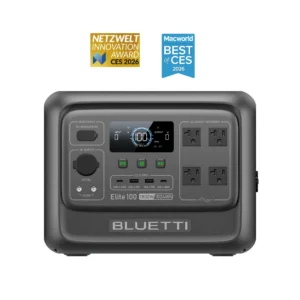
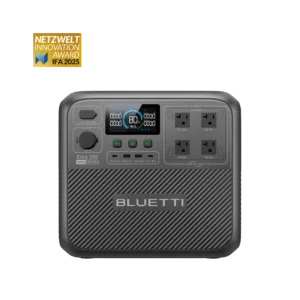
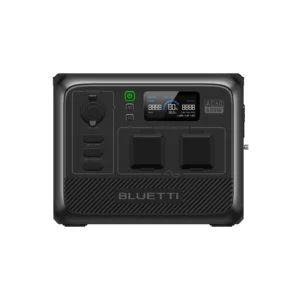
When the power station rides on your back, the only spec that settles the question is weight. Capacity past a handful of phone charges is dead weight; inverter headroom is irrelevant when the heaviest thing you plug in is a laptop. Every Bluetti portable clears the load — the tiebreaker is which one disappears into a pack.
At 3.97 lbs the Elite 10 is the lightest unit in the lineup — roughly half the weight of the next-smallest Bluetti — and the only one that fits inside the FAA carry-on window for lithium batteries (100–160 Wh), so it flies. For this buyer’s actual loads the efficiency picture is favorable: at the 60–100 W range where phone, camera, and headlamp charging lives, usable output runs into the high-80s percent of nameplate. That translates to five to ten phone charges per fill, about five hours on a 14 W modem-class draw, and the built-in three-mode LED — rated 50 hours — is a genuine camp tool, not a checkbox feature.
Charging is genuinely fast once you unlock it: a full recharge in roughly 70 minutes in Turbo mode. That ‘once you unlock it’ is the catch — Turbo must be enabled in the app; out of the box the unit charges at a much slower default rate, and it will feel broken until you find the setting.
There are two limits worth knowing. The 100 W USB-C port doesn’t reliably hold rated output under sustained high-draw loads — owner reports document Starlink Mini reboots and laptop-charge interruptions; ordinary phone and laptop charging is fine, but don’t choose it as a Starlink Mini supply. And the 200 W AC ceiling is a hard wall; this is a device charger, not an appliance runner. No solar cable ships in the box, and the XT60 connector limits third-party panel compatibility. Warranty is three years — shorter than Bluetti’s usual five.
Skip it if: your kit rides in a car rather than on your back — the AC2P below carries nearly twice the capacity for $70 less and adds 12 V-cooler support.
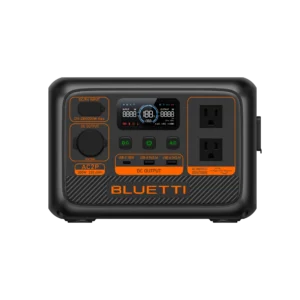
At $129 the AC2P is a different kind of argument. It’s heavier — 7.9 lbs versus 3.97 — so it’s not a pack unit. But for a car camper who wants the minimum viable power station, owner reports put a full day of tablet, camera, and mic charging at around 20–25% remaining, and a 12 V cooler in freezer mode ran over five hours on a single charge. The 12 V DC port the Elite 10 lacks is here. Its review names device-charging campers and travelers as the core buyer and calls the form factor the most-praised trait among owners. It is the lowest cost-per-watt-hour of any sub-1 kWh Bluetti.
One real catch: a recurring, unresolved no-power failure pattern after idle storage or grid events (error codes E113/E116), with a troubleshooting-first support experience. For a unit cycled regularly on trips this matters less than for long closet storage — but buy from a retailer with a clean return path. USB-A ports are slow at 12 W.
The AC2A ($219, 204.8 Wh) sits behind the AC2P on both capacity and price and shares the same error-code failure family — no scenario on this page exists where it wins.
Car camping loads look gentle on paper — a 12 V cooler, some lights, phones, maybe a drip coffee maker at dawn — but they persist for two or three days straight. What decides this segment is how much energy actually reaches your loads per dollar at the draws you’re running. Across the candidates, measured usable capacity diverges sharply from nameplate, and the gap between units is the entire argument.
The decisive number is what independent testing extracted at mid-to-high loads — exactly the regime this segment runs. Measured usable output came in at 869–910 Wh: 869 Wh over DC, 880 Wh at the wall, and around 910 Wh under a 1.2 kW load. That is 85–89% of nameplate reaching your devices. Against the runner-up at this same regime, the gap is real — roughly 200 Wh of usable energy for $50 more, or the difference between a cooler running all weekend and one running most of it.
Its review puts the case plainly: ‘van lifers, overlanders, and weekend campers — this is the heart of the unit’s appeal,’ with a 1:1 solar-to-capacity ratio that refills it in roughly one good sun-hour. Camp noise is measured at 28–32 dB up to around 500 W — inaudible at a picnic table distance — climbing to 46–47 dB only under heavy AC charging or hard discharge. The flat top stacks with a cooler; the 25 lb body is a one-hand carry.
Two catches before you commit. Power Lifting is resistive-only — it won’t start a window-AC compressor or some larger chest freezers; that’s not a camping issue but don’t plan a compressor load around it. The full 1,000 W solar rate requires 48 V+ panel wiring and enabling high-current PV mode in the app (the default caps solar input near 130 W until you toggle it). At 24 V expect roughly 460 W; at 12 V roughly 230 W. There is also a documented early-failure cluster — some units arrive dead or fail inside the first few months. Bluetti replaces under the five-year warranty, but register and test it on arrival before your first trip.
Skip it if: you’re cooking for a group and need appliances running simultaneously — step up to the Elite 200 V2 in the segment below, which adds 800 W of sustained output and nearly double the capacity for $400 more.
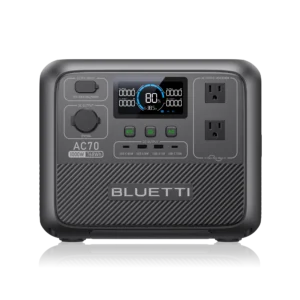
The AC70 is $50 cheaper and 2.5 lbs lighter, and its review calls car camping ‘the AC70’s heartland — the right size for car camping, big enough to matter, small enough not to dread loading.’ Charging speed is bench-verified: 80% in under an hour on a single integrated cable. What it gives up is usable energy at this regime — independent testing puts it at 650–700 Wh under 200 W to 1 kW AC loads, and the 1,000 W output ceiling is 800 W below the pick’s. One note on a number that circulates widely: the ~450–500 Wh figure sometimes quoted for the AC70 comes from low-draw AC measurements around 40 W, where inverter idle losses dominate. That is not this segment’s load, and it doesn’t apply here.
There is a first-year reliability concern: a documented E065 DC-port failure cluster, acknowledged by Bluetti, plus screen and charging failures — warranty honored, but register on arrival. A Keurig-class coffee maker trips it even with Power Lifting on; the AC180-class units handle the same machine. And the minimum AC charging draw (400–500 W in Standard mode) can overload small vehicle inverters.
The AC70P ($699, 864 Wh) adds 96 Wh over the AC70 for $350 more — the AC70’s own review recommends against it at that price differential unless you specifically need its surge headroom.
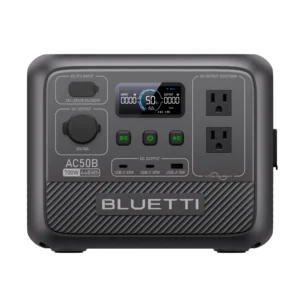
The AC50B earns a mention for one specific buyer: the person whose hard constraint is a 16.5 lb one-hand carry and whose loads stay comfortably under 700 W. At that weight, independent testing found usable output of around 400 Wh at the AC outlet — its review calls the rating ‘honest, slightly conservative’ — and owners run 12 V fridges, lights, and devices across two-to-three day trips topped up with a 100 W panel.
The constraint that limits it is the 700 W ceiling. A kettle or microwave will not run — that hard ceiling is the review’s most consistent source of buyer regret on this unit. At the same $399 as the Elite 100 V2, it carries well under half the usable energy; it surfaces only when the weight itself is the deciding factor.
A camp kitchen is a different problem than a weekend cooler. You need the kettle and the induction burner and the fridge running at the same time, across multiple days, for several people. Here is the counterintuitive thing the Bluetti lineup forces you to learn: capacity tier does not track inverter strength. The 2 kWh unit below carries a 2,600 W inverter; the 3 kWh unit above it carries 2,400 W. Buying ‘bigger’ on battery alone buys you a weaker kitchen. The axis that decides this segment is continuous AC output, and that’s where to start.
The 2,600 W sustained output is the anchor — validated in review testing against fridges, microwaves, kettles, power tools, and a small window air conditioner. That headroom is what lets the kettle and the fridge run together. Combined with measured inverter efficiency of 96% and an idle draw of 9.5–10 W, usable energy at AC loads works out to roughly 1,990 Wh — capacity that its review characterizes as ‘comfortably covering a weekend of fridge, lights, cooking, and device charging with margin to spare,’ with owners routinely reporting leftover charge at trip’s end. A 1.5-hour Turbo recharge means a town stop or a generator hour fully resets a multi-day trip.
Four things to know before the first cook. ECO mode ships on and will cut low-draw AC loads — disable it before trusting an unattended fridge. The display reads apparent power (VA), running roughly double actual watts on some loads; Bluetti confirms this, and a full discharge-and-recharge cycle recalibrates the state-of-charge reading. Under Turbo charging the fan reaches around 45 dB — the 16 dB figure in some materials is a silent-mode, low-load number; don’t plan the unit’s noise behavior around it. And 53.4 lbs with no wheels is a genuine two-person lift — site it once and leave it.
The one hard ceiling: this unit is not expandable. 2,073.6 Wh is what it is; owner feedback in the review names it the most-cited complaint.
Skip it if: your basecamp runs three-plus days without a recharge window and you cook by day only — the Elite 300 below adds nearly another kilowatt-hour of usable capacity, though it costs more and is louder overnight.
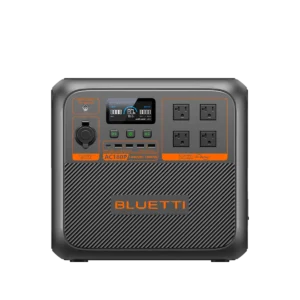
At $499 and 35.3 lbs the AC180P is 18 lbs lighter than the pick and the best raw cost-per-watt-hour in the catalog at $0.35/Wh. Its review validates 1,500 W heaters, 2,000 W microwaves, and 1,800 W coffee makers in real use, and calls camping and overlanding ‘the unit’s strongest case.’ Usable energy at the AC outlets runs to roughly 1,150 Wh at sustained loads.
What it gives up is the decisive axis: 1,800 W sustained versus the pick’s 2,600 W means sequencing the kettle and the induction burner rather than running both. For a group kitchen that gap is felt every meal.
One marketing claim to ignore: the advertised ‘expands to 4,224 Wh’ is not real — Bluetti’s own manual confirms there is no capacity expansion on this unit (Power Bank Mode only). Fans spin up around 200 W, earlier than the sibling AC180. App connectivity is Bluetooth only.
The AC180 ($699, 1,152 Wh) shares the AC180P’s enclosure and 1,800 W output but costs $200 more for 288 Wh less at standard pricing — the AC180P is the better buy on every axis they share.
The Elite 300 earns its mention for one specific scenario: a three-plus day group basecamp where you cook and run appliances during the day and don’t need the unit cycling quietly through the night. Independent testing extracted 2,760–2,873 Wh usable at AC discharge — 92–95% of nameplate, among the best conversion rates recorded in its class — and a continuous fridge runtime of around 54 hours. The 1,200 W solar input and 4,800 W surge offer real headroom for brief heavy draws. At $1,649 it is a serious investment in autonomy.
Two things that keep it from the pick. The inverter inversion holds here too: 2,400 W is less kitchen headroom than the cheaper Elite 200 V2’s 2,600 W, on the axis this segment weights most. And its review includes an explicit noise demotion for tent-adjacent use: 50–53 dB under high load or Turbo charging, with a tester stating flatly he wouldn’t sleep near it. Run it by day and it’s excellent. It is not a tent-side overnight unit.
The Premium 200 V2 ($1,499) carries the same 2,073.6 Wh as the Elite 200 V2 at nearly twice the price. The AC200P L ($1,999, 2,304 Wh) and AC240P ($1,999, 1,843 Wh) both lose to the Elite 200 V2 on cost-per-watt-hour and to the Elite 300 on capacity per dollar — neither wins an axis on this page.
If the battery is going to sit in a truck bed through a desert dust track, absorb lakeside dew, or survive a rainstorm that arrives mid-afternoon without warning, the conversation starts and ends with weather sealing. Everything else is secondary — and the Bluetti lineup makes this simple, because exactly one carryable unit has it.
The IP65 rating — dust-tight, resistant to direct water jets — was validated in rainy-day field testing: water, dirt, and dust handled without drama, aluminum case and sealed rubber port covers intact. Its review describes this segment word for word: the wet-and-dusty camper running a fridge for 16 hours on the standalone unit, and 36-hour fridge runtimes in overlanding use while simultaneously charging devices. No other carryable Bluetti offers this protection — the AC70P, AC180, and AC2P carry none. That is the entire case for the AC60P, stated plainly.
For this segment’s actual load profile — 12 V fridge plus device charging — run the fridge on the DC port. The DC outputs operate at meaningfully higher efficiency than the AC inverter, where usable output at low loads runs around 77% of nameplate. At the 500 W range the AC inverter reaches roughly 86%.
The pricing reflects the sealing: at $1.49/Wh it is expensive energy storage by any comparison on this page. The review is direct about the solo-unit capacity: 504 Wh is ‘marginal for a full weekend’ — the B80P expansion is the practical camping configuration if you want two nights of cold drinks without watching the state-of-charge display.
Three hard limits. The 600 W ceiling rejects microwaves, kettles, and hair dryers — this is a fridge-and-devices unit. Solar underdelivers badly through the narrow 12–28 V input window; two 100 W panels in parallel outperform a single 200 W panel here, delivering around 143 W real-world from a 200 W panel. At hot ambient temperatures (86–104°F) the unit derates to 500 W — exactly the conditions it’s marketed for. IP65 means surviving a downpour; Bluetti’s own manual still advises against operating it soaking wet, and protection drops while port covers are open.
If you need weather sealing and basecamp-level capacity, the AC240P (1,843 Wh, 2,400 W, 72 lbs, IP-rated) is Bluetti’s heavy weatherproof option — but it has not gone through the same full review process as the picks on this page and is not ranked here.
Skip it if: your camps are not genuinely wet and dusty — on every other axis this unit loses to its own siblings, and the segment above offers far more usable energy per dollar for general-purpose camping.