
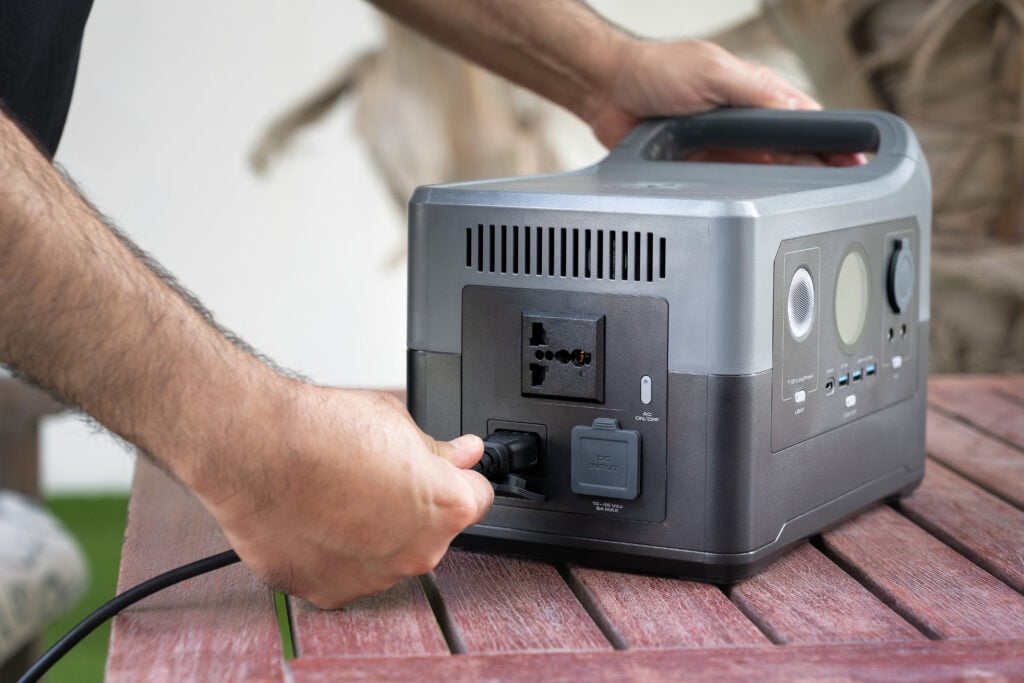

A van build runs on ruthless prioritization — every pound and every cubic inch is contested, and the station has to refill during a drive, not just overnight on shore power. That constraint makes sub-hour recharge and light carry weight the two things that actually matter, and the C1000 Gen 2 owns both.
It’s the lightest 1 kWh-class unit in independent testing — a meaningful edge when the station competes for space with gear, water, and bedding. The recharge story is even more decisive: top it off at a coffee stop or a library outlet and it’s full in under an hour. Pair the Anker Alternator Charger for practical drive-time charging; the 12V car port alone caps near 100W and would take roughly 12 hours to do the same job. For the core van load — a 12V fridge running on the DC port, Starlink, a laptop, lights, and device charging — the DC port bypasses the inverter entirely, so the fridge barely taxes the pack. Owner and field reports put a 50W fridge running three days on a charge. Idle is near-silent under 200W, and the sub-10ms UPS switchover means nothing downstream notices a shore-to-battery transfer.
There are real setup rules to follow before going off-grid. Complete the Bluetooth app pairing first — leave it unpaired and the outlets may not turn on. The 600W solar ceiling requires 29–60V panels; the more common 11–28V panels cap near 200W even wired in parallel, so match panel voltage, not just wattage. UltraFast charging needs cells above 68°F, so a cold morning will slow the recharge. And there’s no expansion path — 1,024 Wh is the ceiling.
Skip it if: your build runs a power-hungry creative rig — drones, cameras, laptop, fridge, and lights simultaneously — or you spend multiple days off-grid between drives; in that case the C2000 Gen 2 below carries twice the energy and an 800W alternator charging path at 17 extra pounds.
The flipping axis is capacity versus carry weight. It doubles the C1000 Gen 2’s watt-hours to 2,048 Wh, adds an 800W alternator charging path — eight times what a car socket delivers — and charges from solar and AC simultaneously. Its idle sits at 9–18W, the lowest in the Anker line, so it doesn’t bleed between drives. For a power-hungry van build or a longer off-grid stretch, it’s the stronger fit; it loses the van life segment only on the 17 extra pounds and a recharge that, while still fast at roughly 1.5 hours, isn’t the sub-hour turn of the C1000 Gen 2.
A travel trailer parked off-grid for a few days asks one specific thing of a power station: plug straight into the rig’s 30A inlet and run the fridge, microwave, lights, fans, and chargers without the owner managing an extension cord or a power strip. Once you’ve taken the rooftop AC off the table, everything else comes down to how cleanly the unit feeds that TT-30 inlet and how well it refills while the rig is parked — solar during the day, a short generator window to top off. The C2000 Gen 2 wins on both counts.
The dedicated NEMA TT-30R outlet is the starting point — it plugs straight into the trailer’s 30A shore inlet, no adapters. From there, the replenishment picture is what separates it from everything else at this capacity. It idles at 9–18W, the lowest figure in the Anker line, which matters between trips and overnight when nothing is actively drawing. It charges from solar and AC simultaneously, so panels-out while a generator runs is exactly the scenario it was built for — a combined 2,600W input charges it in about 58 minutes. The 800W alternator path covers a drive day. Owners running the full RV load — fridge, microwave, lights, fans, chargers — report extending boondocking stays by a day or two; one owner kept a 5-gallon electric water heater warm overnight near freezing and woke to more than 70% remaining. At 41.7 lbs it’s the lightest 2 kWh unit owners in this category typically compare against. Microwave and kettle peaks sit well within range — bench testing put burst output near 6,000W.
One ceiling to carry into your planning: the TT-30R outlet is capped at 20A/2,400W by the inverter — not true 30A service. For everything this segment runs, that’s plenty. The moment a rooftop air conditioner enters the picture, the math changes and you’re in the next segment down.
Skip it if: you want to start and run the rooftop AC off battery — that’s a different load and a different unit; jump to the F3000 in the AC segment below.
It’s the same basic chassis as the F2000 with 25% more battery — 2,560 Wh — and WiFi remote monitoring added. Independent bench testing verified roughly 2,480 Wh usable. The case for it is narrow and real: the trailer owner who wants the extra 512 Wh over the C2000 Gen 2 and values being able to check in on the rig remotely, and will pay the premium for those two things — while accepting that it cannot charge from AC and solar at the same time. Cold-weather note worth planning around: one owner’s unit shut down around 35°F, so insulate it for shoulder-season trips.
The Anker SOLIX F2000 has the same TT-30 outlet and the same capacity as the C2000 Gen 2, costs one dollar less, and loses this segment on every axis a parked trailer weights. It cannot charge from AC and solar simultaneously — AC takes priority, which is exactly the panels-out-plus-generator-window boondocking pattern. Its idle is roughly 45W against the C2000’s 9–18W, and long-term owner records include units draining to zero over months of sitting between trips. Its genuine strengths are a well-regarded wheel-and-handle system and a reputation among multi-year owners as the quietest station in the line — take it if your boondocking is drive-up and you top off before every trip; it loses ground the moment parked replenishment matters.
Four Anker stations carry a TT-30 outlet and a 2,400W-plus inverter. On paper, any of them might seem capable of running a rooftop air conditioner. The field record says otherwise — and the difference between units that handle the motor-start inrush and units that collapse on it is not visible on the nameplate.
Compressor startup pulls a momentary spike far above running watts. Two of the four documented candidates folded on exactly this load; a third is capped below what it takes to be reliable. One unit in the Anker line is confirmed handling it, and that’s the F3000.
What cleared the field: one owner’s rooftop AC high-cool startup — the worst-case inrush scenario — was handled where, in the owner’s account, lesser units fail. The inverter sustains a true 3,600W from the TT-30R for 15 minutes or more, with an overload threshold measured around 5,300W, and it surge-started a 15A table saw and a 12A vacuum simultaneously. The surge spec on this page is the honest number — the 4,860W ‘SurgePad’ figure on some listings is a voltage-boosting mode, not the same thing as clean surge capacity.
The F3000 is also the only Anker with full 3,600W pass-through — it recharges and powers the rig simultaneously at full speed, where the F2000 and F2600 cap pass-through at 1,440W. Idle lands at roughly 20–35W, well under the F3800‘s ~80W. The horizontal wheeled-suitcase chassis stores more cleanly in an RV bay than a tower. The Anderson 30A DC port integrates directly with camper bus systems. Expansion reaches 24 kWh if you eventually need it.
Before deploying it, a few real limits to account for. This is a 120V-only unit — 240V service requires two F3000s plus the Double Voltage Hub. The AC charging cable and high-voltage solar connector are proprietary; carry a spare on a deployed rig because these are single points of failure. Standby runtime measured roughly 30% short of the advertised 5-day claim, so plan conservatively. The four NEMA 5-20R outlets are tightly spaced and bulky adapters will block neighbors. iOS firmware updates are currently broken — use Android. And even with 3 kWh behind it, a rooftop AC is pulling the pack down steadily: figure on a couple of hours of compressor cooling per charge and plan to pair it with solar or a generator for sustained cooling.
Skip it if: your AC use is brief or your unit has a soft-start kit — in that case the C2000 Gen 2 handles short AC bursts for $600 less and 50 pounds lighter; or if you need 240V single-unit service, in which case you want the F3800 Plus in the next segment.
The flipping axis is surge headroom. Its TT-30R is capped at 2,400W and its AC capability is framed, in owner experience and in the field record, as a short-burst option rather than a reliable motor-start-and-run path. For the rig with a low-draw or soft-start AC unit, or where AC cooling is measured in minutes rather than hours, it’s $600 less and 50 pounds lighter with all the boondocking strengths of the trailer segment. For anyone who needs the air conditioner to start reliably and stay running, the F3000 clears a wall this unit sits against.
The Anker SOLIX F2000 and F2600 are both vetoed on the same documented failure mode. The F2000: an 8,000 BTU window AC ramps to 1,900W then collapses to 90W and shuts down; a 20A welder trips it in 5 seconds; saws shut it down in half a second through a 30A adapter. The F2600 shares the same 2,800W honest surge — the ‘3,600W SurgePad’ is a voltage-dropping boost mode, not true surge capacity — and a 15K BTU rooftop AC drains it in roughly 1.5 hours, with the assessment being that it supplements a propane generator rather than replacing it for AC use. Both are capable, well-regarded TT-30 sources for resistive trailer loads, which is exactly where they appear in the segment above. The veto applies only to motor-start inrush; it doesn’t touch their other credentials.
A 50A fifth-wheel or big motorhome runs a different electrical world — residential fridge, 240V circuits, potential transfer-switch integration, multi-day capacity requirements. The two Anker stations built for this job share the same 3,840 Wh pack and the same 6,000W split-phase inverter. On the spec sheet they’re nearly twins. In the field, one specific capability separates them: can you run a generator to recharge while 240V loads stay live?
The original F3800 cannot do this. The F3800 Plus was built to. For a generator-dependent rig, that’s the whole decision.
The capability that justifies the premium: it recharges from a 240V generator while simultaneously powering 240V loads — confirmed in testing at roughly 6,000W in and out at once. That was the single most-cited failure of the original F3800, addressed directly in the Plus design. For a 50A rig that needs the generator humming while the residential fridge and 240V circuit stay live, there’s no workaround required here.
The wider MPPT input range also pays off with real solar arrays: panels wired in series at 48V produced meaningfully more output than the same panels in parallel in testing, because the 165V ceiling lets series strings actually reach high voltages. Six thousand watts of split-phase output is sustained, not a brief peak. Update the firmware on arrival — a post-launch update cut idle drain to among the best tested, around 1.5–1.6% per hour with the inverter on.
Plan around the documented operating conditions before installing it. Single-unit generator charging caps near 3,300W — reaching the 6,000W headline requires two expansion batteries. True UPS switchover (measured at 14.3ms) covers only the three leftmost 120V outlets during 120V wall charging; the 240V ports transfer in roughly 0.5 seconds, fast but not UPS-class. When 240V generator charging is active, the six 120V receptacles go dark. The generator bypass supports a single unit only. At 136.7 lbs this is a semi-permanent bay installation.
Skip it if: your recharge is mostly wall or shore power between stops and you use the generator only occasionally — the F3800 delivers the same single-unit 240V and the same 6,000W output for $700 less, with the understanding that generator recharge and 240V loads cannot run at the same time.
The flipping axis is recharge architecture. For the 50A rig that charges primarily from the wall or shore power and uses the generator only as a backup, the F3800 delivers the same sustained 6,000W split-phase output via its built-in NEMA 14-50 and L14-30 at $700 less. What it cannot do: accept a generator on its 120V AC input while 240V loads stay live — the 240V output and three of the six 120V outlets shut off during AC charging. The workaround (feeding power through the DC solar port via a 48V battery or a chargeverter) exists but adds complexity. Most 30A RVs have no business in this tier at all — the F3000 is the practical ceiling for single-unit 120V coverage; the F3800 family is the step for genuine 50A, 240V service.