
The default question in this class is simple: which box gives the most durable, capable storage for the least money? Chemistry is the floor — a unit with ~500 cycles of real-world life doesn’t belong in a ‘buy it once’ conversation — and once NMC is ruled out, the remaining LiFePO4 units sort quickly by price and capacity. The Anker 535 PowerHouse wins both.
At $299.99 for 512 Wh of LiFePO4, the Anker 535 is the best-value storage in this band — and it isn’t close. It carries the largest capacity of the LiFePO4 options here and the lowest price per watt-hour. The chemistry matters: 3,000-cycle LiFePO4 backed by a five-year warranty means this box should still be doing useful work a decade from now, not degrading toward replacement in three. Independent testing found no measurable capacity drop across 50-plus cycles, which matches what the chemistry promises.
In practice it runs as a capable multi-device hub — phone, laptop, Switch, and headphones simultaneously — and its standby self-discharge (~2–3% per month) means you can keep it charged and waiting for an outage without finding it half-dead when you need it.
There are two catches worth knowing. The 500 W ceiling means anything that pulls harder — a hair dryer, a small microwave — will trip the inverter. And a documented outlet quirk can block some grounded three-prong cords; check your specific plugs before you rely on it. There’s also no app and only a single USB-C port, which reflects its age — but neither limitation affects what this segment’s buyer is actually doing with it.
Skip it if: you need to run appliances above 500 W — go to the Most Output section and look at the Bluetti AC50B instead.
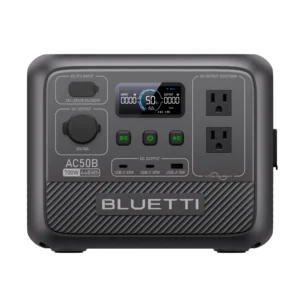
The AC50B is the fastest-charging and highest-output unit in the band, and it’s a genuinely excellent box — just not on value grounds at its $399 list price. At $0.891/Wh it’s the priciest-per-Wh LiFePO4 option here, and it carries 64 Wh less than the Anker. The trade flips in the buyer’s favor only if output or recharge speed is what you’re actually buying; for pure value, the Anker wins clearly. Full details in the Most Output segment below.
The Explorer 500 is lighter than anything else here (13.3 lb) and offers a regulated 13.2 V DC output that CPAP users occasionally prefer — but it runs on NMC lithium-ion rated for roughly 500 cycles, while LiFePO4 units at lower prices are available on this very page. Jackery’s own coverage of the 500 effectively concedes it has been lapped by newer chemistry. It earns a mention only for buyers who find it substantially discounted below the Jackery 1000 v2 or similar — at or near its $329 list price, the Anker 535 is the straightforward answer.
If your goal is to actually run things — a 12-volt fridge alongside a small AC load, a kettle, a power tool charger — most of this class will disappoint you. Three of the four in-band units cap at 500–600 watts. One doesn’t. The Bluetti AC50B is the only unit here that clears 700 watts of real, sustained output, and it recharges faster than anything else in the class. That’s the whole argument.
The AC50B delivers ~400 Wh at the wall under real loads — independent testing puts usable capacity at roughly 90% of nameplate, meaning the rating reflects what you actually get rather than an optimistic ceiling. It runs loads the 500-watt competition simply rejects, and it comes back from empty in about 65–70 minutes from AC, with a built-in cable and no external brick to lose. The 80% mark lands in around 45 minutes — fast enough to matter between uses on a busy day.
One spec on the box deserves a direct correction: the ‘1000 W Power Lifting’ mode is a resistive-loads-only, voltage-sagging feature that’s disabled by default. It managed a 1000 W kettle at roughly 715 W in testing but couldn’t run a 700 W microwave at all. Plan your loads around 700 W real output; the bigger number is not one to size against. Similarly, Bluetti positions this unit as not UPS-capable for critical equipment — testing suggests ~20 ms switchover works for PCs and 3D printers in practice, but that’s observed behavior, not a manufacturer guarantee, so don’t stake anything irreplaceable on it.
The standby drain is also worth noting: the AC50B ships with ECO mode on, which cuts the output below 10 W AC or 5 W DC. If you’re running a low-draw device continuously, disable it first.
The Explorer 600 Plus isn’t a 500 Wh unit — it’s a 632 Wh, 600-class machine — and it’s here only because it’s the honest answer for buyers who find themselves bumping against the AC50B’s ceiling. It delivers 800 watts of real output, more capacity than anything in the band, and a better price-per-watt-hour than the AC50B, all at 16.1 lb. Its 4,000-cycle LiFePO4 rating and 20 ms UPS round out a genuinely strong package. If you’re sizing loads in the 700–800 W range and capacity matters, this is where to go — just know you’re stepping out of the 500 Wh class. One habit to build: keep the outputs switched off when it’s in storage. One test recorded 23% drain over 12 hours with outputs left enabled — a real loss if it sits for a week between trips.
Skip it if: value per watt-hour is your main criterion — the Anker 535 in the Best Overall Value segment gives you more capacity for $100 less.
Sleeping next to a power station changes the priorities completely. Capacity isn’t really the question — everything in this band can clear a night at CPAP draw. What matters is whether the unit will stay quiet, stay on, and be ready when you need it. Two units in this class fail at least one of those tests in documented ways. The Anker 535 passes all three.
There’s a physics reason to use the DC port for a CPAP rather than AC: the inverter’s idle draw at this capacity tier is large enough relative to a 40-watt load that running AC would eat roughly a quarter of your effective draw before the battery even counts. DC bypasses that overhead entirely, and the Anker’s 512 Wh on the DC path comfortably covers one to two nights at typical CPAP draw — more with the humidifier off. Plan around that range, not around any higher figure.
The Anker earns this segment on three grounds. It’s the quietest of the validated units here — essentially unnoticeable from a few feet away, where the AC50B runs at 45 dB. Its power-saving mode is disableable, which matters: a low-draw cutoff that silently kills the output below a threshold is exactly the failure mode that eliminates two rivals here, and on the Anker you can switch it off before bed. And its ~2–3% monthly standby drain means a unit kept charged for outage nights won’t surprise you with a dead battery — a trait that matters more than fast recharge when the use case is emergency readiness rather than daily cycling.
Its 500 W ceiling and the outlet quirk with some grounded plugs are both irrelevant to a 40 W bedside load. The ~20 ms switchover works as a short outage bridge, though the 120-watt charger caps how much continuous load it can sustain in that role — fine for a CPAP and a lamp, not a substitute for a proper UPS on anything critical.
Skip it if: you’ve had multiple consecutive outage nights and need fast recovery — the Bluetti AC50B’s 45-minute recharge to 80% makes it the better choice for stringing days together.
Owner reports of the AC50B running a ResMed AirSense 11 across multiple nights on DC (humidifier off) make it the most specifically validated CPAP unit in this comparison — that’s a real credential. And its 45-minute recharge to 80% is the right tool if an outage runs across multiple nights and you need the battery back up before the next evening. Two things to sort before you sleep next to it: ECO mode ships enabled and will cut a low-draw CPAP; disable it. And its 45 dB fan is audible — not loud, but present. If bedside silence is the non-negotiable, the Anker wins cleanly.
Two units don’t make it here. The Jackery Explorer 500‘s NMC chemistry is one strike, but the documented low-load auto-shutoff is the sharper one — below roughly 10 watts sustained it can cut the output, which is a real therapy-interruption risk on a cool night when the CPAP drops demand. Its regulated 13.2 V DC output is a genuine plus for CPAP use, but not enough to overcome a documented shutoff risk. The Jackery Explorer 600 Plus is a strong LFP unit, but an owner was woken around 5.5 hours into a night by the cooling fan ramping under thermal load — bedside use is exactly where that matters most.
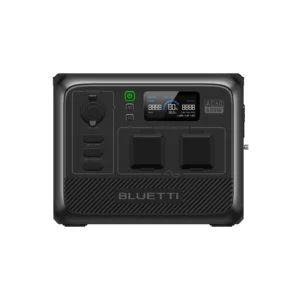
If the power station lives in a truck bed, sits through morning dew at a lakeside camp, or gets caught in rain, one question settles the whole segment: is it sealed? In the 500 Wh class, exactly one unit is. The Bluetti AC60P carries an IP65 rating — dust-tight and water-jet resistant — and nothing else at this size from any brand in this comparison matches it. The segment exists only for buyers with a real weatherproofing requirement; if yours is just ‘outdoors,’ the Best Overall Value pick handles that without the cost premium.
The IP65 seal has been validated in rainy-day field testing — dust-tight and water-jet resistant isn’t a marketing claim here. That alone justifies the segment for the right buyer. The AC60P also carries the longest warranty in the band at six years, recharges in about 1.25 hours from AC, and can expand to 2,116 Wh via the B80P battery — which is the honest configuration for a full weekend of camping. Standalone, 504 Wh is marginal for two days with a fridge; factor the expansion in if that’s the use case.
The output derates from 600 W to 500 W above 86°F — a real constraint in hot-weather outdoor use. The solar input has a narrow 12–28 V window that limits what panels pair well with it; real-world intake from a nominally 200 W panel runs meaningfully lower than the rating. A UPS function is present but unlabeled by Bluetti; a sibling unit measures ~15 ms switchover, but treat it as unwarranted rather than guaranteed.
The honest thing to say about value: at $749 and $1.486 per watt-hour, the AC60P costs roughly two and a half times what the Anker 535 costs per unit of storage. Bluetti’s own coverage of it recommends the AC70P or AC180 for buyers who don’t specifically need the weatherproofing. This unit earns its price only if IP65 is a genuine requirement — and if it is, there’s nothing else to buy in this class.
Skip it if: you don’t have a specific weatherproofing requirement — the Anker 535 does everything this unit does for general outdoor use at less than half the per-watt-hour cost.