
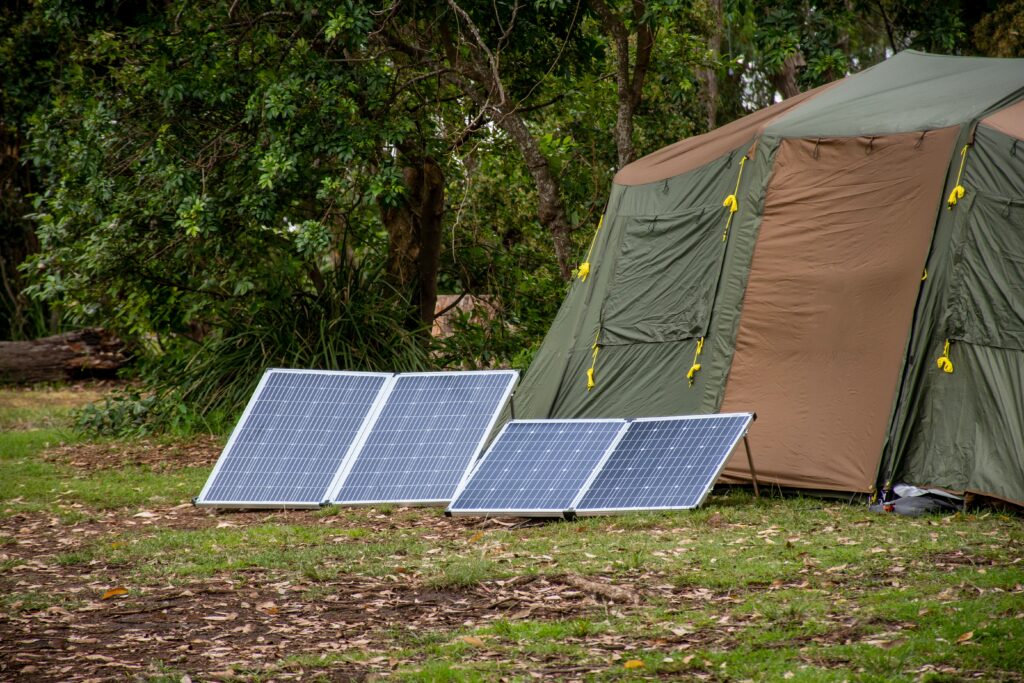
When the panel rides on your back, weight is almost the whole argument. A panel you genuinely carry on foot has to earn every ounce — and the one most on-body buyers actually want is a panel that can charge a phone, camera, or drone directly, without a separate battery adding more carry weight. Those two constraints together narrow the field sharply.
The SolarSaga 100 Air wins this segment on the two axes that define it. At 7.1 lbs it is the lightest 100W panel here — roughly 27% lighter than the next lightest option — and it is the only one a reviewer described as genuinely suitable for carrying on foot. That weight gap is not a rounding difference; it is the difference between a panel you will actually pack and one you will leave in the car.
The second thing it does that most panels here cannot: a pair of onboard ports — USB-A (5V/2.4A) and USB-C (5V/3A) — charge phones, cameras, and drones directly off the panel, with no power station in the loop. Field use produced 6–8 phone charges per day plus continuous camera and drone top-ups on a sunny day. For a backpacker or kayaker who wants to skip carrying a separate battery, that capability is the whole case for this panel over everything else on the page.
The sealing is the best in the 100W class at IP68, and it held up through overnight frost and dew in multi-day field use. The W-fold deploys in about 60 seconds, and stake holes let you anchor it in wind.
One honest caveat before you buy: this pick carries less certainty than the others on this page. The field record is essentially a single extended test; strong-sun output has not been independently quantified; the warranty length and the 4,000-fold-cycle durability claims are unverified manufacturer figures. For an occasional on-body trip panel, that uncertainty is a tolerable trade — the longevity question matters less when you are folding it a dozen times a year rather than every weekend. But if you want a proven track record before committing, the runner-up is the safer choice.
The proprietary DC8020 connector locks station charging to Jackery gear. Universal charging through the USB ports works with anything, but if you want to feed a non-Jackery station, factor in the adapter situation.
Skip it if: you need to charge through a power station from a different brand, or you want a panel with a longer verified field record — in either case, the EcoFlow 110W Portable runner-up is the better fit.
At 8.8 lbs the 110W is the second-lightest panel here, the cheapest on the page at $169, and it carries a confident ‘Buy If’ verdict backed by measured strong-sun output of 80–101W — close to its rated figure, which is unusual in this class. Its ballistic-nylon carry case is the most praised physical detail in the 100W segment: padded handle, doubles as an angle stand. It also has IP68 sealing and a 1-year warranty.
The reason it is the runner-up and not the pick: it has no onboard USB ports at all. It charges only through a power station, and the solar-to-XT60 cable is not even included in the box. For a backpacker who wants to leave the battery at home, that is a disqualifying omission. It is the right panel for the weight-conscious EcoFlow RIVER owner who will pair it with a station in fair weather and values the proven output and the excellent case over direct-charge convenience. Note that output collapses to around 20W under cloud cover, and the case-as-stand has a tendency to flop in wind.
The best-built 100W panel in the segment and the longest warranty in the class at 18 months, with a complete in-box cable kit covering MC4, XT60, and DC7909. At 10.6 lbs, though, its own review calls it the wrong tool for ultralight use — it does not fold down the way the pick does for on-body carry. At $219.99 it makes most sense as a car-camping 100W panel for an Anker C300-class station, not an on-body one. One note: there is a real quality-control tail on this model — test your unit during the return window.
Broad Bluetti station compatibility and a respectable single bench result, but at 10.9 lbs it is the heaviest 100W panel here, and it carries a thin-evidence ‘Watching’ verdict with no durability data on record. Listed at $199 (the $299 figure you may see elsewhere is the struck-through original price). Worth considering for a Bluetti-station owner who needs MC4 connectivity and is not weight-first.
Most portable solar buyers are in this segment. You drive to a campsite, carry the panel from the car, set it up, pack it down at the end of the day, and do it again the following weekend. For that pattern, peak output in a lab is less important than whether the panel is still working after a summer of being handled. A portable panel’s core job is getting moved, and the one that decides this segment is the one whose record shows it can take that abuse.
The SolarSaga 200W wins this segment because it has actually survived what everyday carry demands. After 90 days of rough handling on rocky terrain, long-term field testing found no cell damage and no measurable performance loss — and a 5-year warranty, the longest in the 200W class, backstops that track record. For a panel you fold and haul every weekend, that evidence matters more than any peak-output figure.
It also delivers honest output: independent field testing measured it at or near its 200W rating in strong, aligned sun, using the onboard SolarTarget shadow sight to nail the angle. That kind of label accuracy is genuinely uncommon in a class where most panels fall short of their rated figures. IP68 sealing means you can leave it out in rain without pulling it in, and at 14.33 lbs it is the lightest 200W panel here — easy to carry solo. The onboard USB port lets you charge phones and cameras directly at camp without running through the station.
There are a few things to know going in. The DC8020 connector is proprietary to Jackery, which matters more for a buyer not already in that ecosystem — third-party adapters work but lose the optimized fit. At $379 it is the priciest pick in this segment. A small cluster of field reports notes a panel-end connector issue (one documented burn-out, one loose seat) — seat the connector fully and support the cable weight rather than letting it hang. The double-kickstand design has a middle-sag tendency and can tip in wind; weight the legs.
Skip it if: you are not in the Jackery ecosystem and connector universality matters to you, or you handle the panel gently at a single site per trip — in that case the EcoFlow NextGen 220W runner-up gives you better output at a lower price with a universal MC4 connector.
The right choice for the buyer who handles the panel with some care and wants the best real-world output at the lowest price. Independent testing measured 180–210W in strong aligned sun, occasionally hitting 215–240W in cool conditions — the best output numbers in the 200W class. At $299 it is the cheapest panel in this segment, it uses a universal MC4-compatible connector that pairs across brands, and the integrated kickstand with a working angle guide makes setup straightforward.
The reason it is the runner-up: its review documents a recurring cracking pattern at the hinge and panel edges under repeated folding and transport — the precise pattern of use this segment describes. The review is explicit that a buyer who hauls and folds a panel every weekend on rough ground should not rely on this one. The 12-month warranty provides limited cover against that failure mode. For the buyer who sets up at a single site per trip, handles the glass carefully, and wants the best watts-per-dollar with universal connectivity, it is a strong pick. One note on the bifacial upside: the back-panel gain is only 5–10% on grass — you only capture it meaningfully on sand, concrete, or snow.
The best partial-shade tolerance of the 200W class (parallel-wired panel sections) and universal MC4, at $349 (the $499 figure you may see is the struck-through original price). The carry handle is a documented failure point — self-tapping screws into thin plastic that frequently breaks on first carry, which is a direct portability problem for a panel in this segment. It is also IP67, not IP68, so bring it in for rain. Fine for the intermittent Bluetti-station owner who baby-handles the panel; not the choice for anyone who carries it regularly.
A clean pairing for an Anker SOLIX station, but the worst value in the 200W class at $499. Independent testing measured output at 156–160W in full sun — meaningfully below the 200W rating — dropping further in hot climates and to around 25W under cloud. The legs are flimsy and no warranty period is stated. Anker-ecosystem use only.
A different shape of answer for the scalability-minded EcoFlow buyer. Each panel weighs 9.26 lbs — the lightest per-piece carry of anything on this page — output meets or beats the rated figure, IP68 sealing, and a 5-year warranty. At $169 per panel it offers the best per-watt value on the page. Deploy one panel on a light day or build a larger spread; anchor each panel against wind. The trade is multiple connections and a form factor that is not a single folded unit.
There is a real tension at the high end of this category: the panels with the most watts are also the ones most likely to require two people to set up and move. That tension is what this segment is about. The goal is maximum watts from a single panel — but the panel has to remain something one person can genuinely carry alone. Where a fixed-array or boondocking guide can treat a 35-lb panel as an acceptable compromise, a portable-panel guide cannot. A panel you cannot move alone is not a portable panel.
Every high-output panel that competes with the 500X weighs 30–35 lbs. A reviewer who tests competing panels called the 500X the lightest 500W panel he had handled. That 8–13 lb difference is what decides this segment: the heavier rivals were set aside not because of their output, but because their own reviews describe setup and movement as a two-person job — which disqualifies them from a portable-panel guide regardless of their watt ratings.
At the right angle the 500X delivers serious power. Tilted 20–30° toward the sun, independent testing measured around 400W; at near-optimal angle in clear sky, close to 495W. The bifacial TOPCon cells hold output meaningfully when one section is shaded — 330W with one of six sub-panels blocked. IP68 sealing and a 5-year warranty give it the best endurance specs of any high-output panel here. It folds lengthwise for transport and fits an RV hatch or car trunk.
Tilt is not optional — it is the core operating requirement of this panel. Laid flat in the accordion pose shown in Jackery’s own marketing photos, it produces only around 250W, roughly half of rated. The ~400W figure requires a 20–30° tilt and an east-west orientation, and the panel ships with no guidance on achieving that angle. Plan your siting before you arrive. The 10-foot DC cable is a siting constraint — third-party extensions void the warranty. The 500X also cannot be mixed with a smaller SolarSaga panel on a shared-MPPT station input. For wiring into a station with a high-PV input floor (such as 135V minimum), you need at least four panels in series; three panels at 41.7V Vmp each reach only 125.1V, which falls below that floor. At $799 it is the most expensive panel on this page.
Skip it if: the extra carry weight of 30 lbs is not actually a problem for you and maximum real-world harvest is the goal — in that case the Bluetti PV350 runner-up outproduces the 500X in measured output per setup, at a lower price.
The runner-up earns its place on one very specific axis: real-world harvest ratio. Independent testing measured 280–330W in good-to-strong direct sun — 80–90% of the 350W rating — and in a side-by-side shade test it out-produced a 400W glass array. The adjustable stand makes angle optimization straightforward, and at $599 it is the lowest-priced high-output panel here (the $849 figure you may see elsewhere is the struck-through original price).
Why it is the runner-up: at 30.6 lbs it sits at the upper edge of what one person can reasonably carry alone, heavier than the 22-lb pick. It is also IP65 — splash-resistant, not rain-proof; bring it in for rain or snow. The warranty is 1 year. When the ability to carry the panel alone is the binding constraint, the lighter panel wins. When raw harvest per setup is the goal and you can manage the weight, this one edges ahead. One important voltage note: its 46.5V Voc is incompatible with smaller Bluetti stations — mid-to-large models only. Also verify the spec sticker reads 46.5V Voc at purchase; a regional variant called the PV350D has a different voltage profile that some MPPTs will cap incorrectly.
Honorable mentions — panels that fail the portability test
Two high-output panels landed here specifically because their own reviews describe them as beyond one-person handling.
The EcoFlow 400W Portable offers 400W, IP68, and the best per-watt value of the high-output set at $599. Its review’s intended use is mobile deploy-and-stow. But that same review calls it a ‘two-person setup’ and ‘back-breaking’ at 35.3 lbs — it does not clear the one-person carry requirement this segment is built around. Its case-kickstand sags under the panel’s weight and a DIY stand is often needed. Worth considering only if you carry it infrequently and over short distances.
The Anker SOLIX PS400 has the best build quality of the high-output panels and IP67 sealing, but at 35.3 lbs a full-time RV user called it ‘unmanageable for solo setup’ and sold it. Its snap-button stand fails with no practical fix, making repositioning unreliable. At $699.99 it fails the portability requirement on weight and on the stand — it is a set-and-leave panel, not a portable one. One wiring note: keep series strings to a maximum of seven panels; eight at 57.6V Voc each would exceed a 450V system input ceiling.
The EcoFlow 125W Bifacial Modular is a different kind of answer to maximum portable output. Instead of one 35-lb panel, carry four 9.26-lb pieces — 500W total, with each piece well within one-person handling. Output meets or beats the rated figure per panel, IP68, 5-year warranty, at $169 per panel. The trade is multiple connections and the need to anchor each panel individually. For a buyer who would rather make two trips with manageable pieces than wrestle a single heavy panel, it is the best per-watt value on the page at $1.35/W.