
When you purchase through links on our site, we may earn an affiliate commission. Learn more.
Jackery makes a lot of stations. They span two to five pounds of carry weight, double-digit hours of runtime to barely enough for a weekend, and price tags from under three hundred dollars to over a thousand. Every one of them is technically a camping power station. Almost none of them is the right camping power station for every camper.
The tension is real: the unit that fits in a day pack is the wrong box for a group running an induction burner; the tank that powers a camp kitchen for three days is the wrong carry for a hiker who just needs to charge a phone. A global ranking would mislead more buyers than it helps. This page ranks within situations instead — five of them, each with a different pick, each chosen on the axis that actually decides it.
One note that applies everywhere: current-generation Jackery stations use a proprietary DC8020 charging connector. Older Jackery cables and most third-party solar panels won’t connect without an adapter that is not included in the box. Sort the adapter before you count on solar or car charging in the field.
Use the table below to find your situation, then jump to that section for the full case.
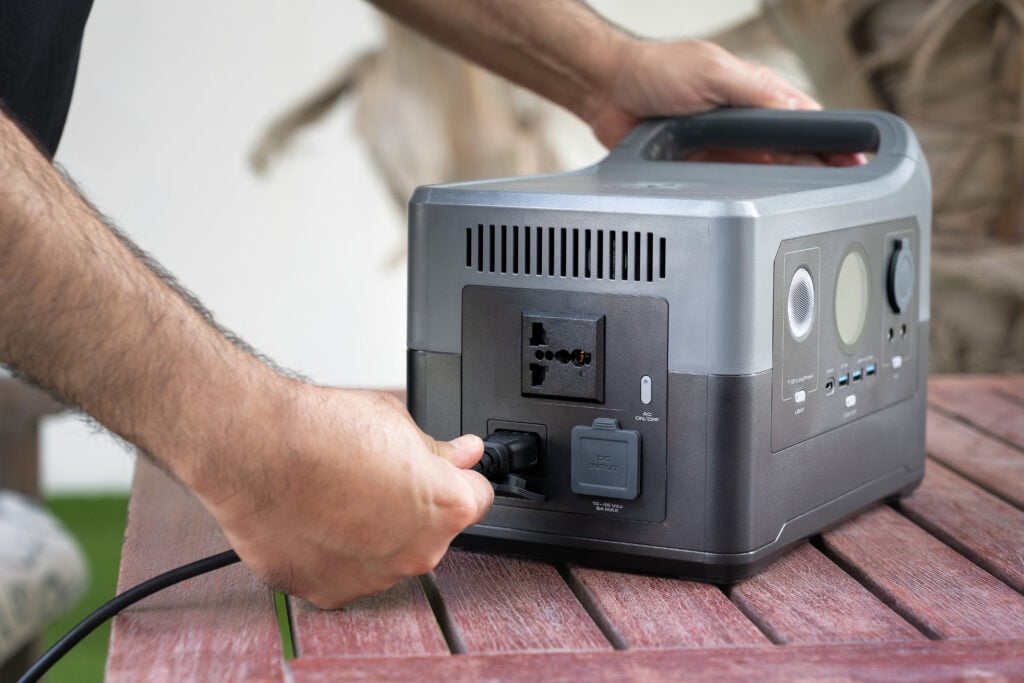
When the power station goes on your back, the weight on the label is the only spec that ultimately matters. Everything else in the lineup either hauls too much, costs more than your device budget demands, or brings capacity you’d never consume before you’re back at a trailhead charger. The 300 v2 is what remains when you apply that filter honestly.
At 8.16 lbs with a folding handle, this is the lightest station Jackery makes, and our review of the Explorer 300 v2 names the weekend device-charging camper as exactly the buyer it’s built for: ‘keep your devices alive across a weekend without hauling a heavier brick.’ The LFP chemistry is the meaningful upgrade over its predecessor — roughly 4,000 cycles versus 500, which is the difference between a decade of use and replacing the unit in a year of heavy trips. The wall recharge to 80% in about an hour fits any pre-trip morning routine.
Performance at this segment’s real loads traces to Jackery’s published specs rather than independent bench testing, so treat the numbers as consistent planning figures rather than lab-verified results. That said, they are coherent: a 65 W laptop runs roughly 3.7 hours, a camera battery setup at 25 W gets eight to twelve full charges across a weekend, and phones charge well over two dozen times before the battery is gone. That is more than enough for a solo trip where the heaviest draw is a laptop.
The boundary is blunt: this is a device charger, full stop. A 60–80 W mini-fridge gets three to four hours, and less in heat. If a powered cooler is part of your kit at all, this is not your station — jump to the 12V fridge segment below.
Skip it if: anything with a compressor is in your kit, or if you’re car camping with a partner and want headroom for lights and fans — the Explorer 600 Plus is the next station up.
Nothing in this segment demands a big station. The question is whether the lighter, cheaper box has enough runway for the whole trip — and for two people running phones, lights, a fan, and air pumps over two or three nights, the answer the evidence gives is yes, with margin left over.
Owner reports tell the story directly: a three-day trip running phones, fans, and air pumps ended at 25% remaining; a two-night trip ended at 80%. The Explorer 1000 v2 carries 70% more capacity and costs $70 more — but if the battery is still mostly full when you pack the car on Sunday, those extra watt-hours are weight you paid to carry and never used. The 600 Plus is the ‘sweet spot’ our review names for exactly this use case, and at a measured 16 lbs it is genuinely one-person portable. A ~1.5-hour wall recharge means it leaves home full every time.
There are real catches, and they’re worth knowing before you commit. The cooling fan ramps audibly under sustained thermal load — one owner sleeping beside it was woken around 5.5 hours into the night. Running loads off the DC port instead of AC keeps it cooler and quieter, which matters for tent use. A standby drain exists when outputs are left enabled with no connected load; the exact rate comes from a single owner’s measurement, so treat the figure with appropriate skepticism, but the behavior is real enough that switching outputs off overnight is the right habit regardless. Early units in this line showed a cluster of F3 errors and charge-refusal failures; the warranty path is cleaner through Jackery direct than through Amazon, so buy accordingly. And the 800 W inverter ceiling is a hard wall — no kettle, no coffee maker on this box.
Skip it if: a 12V compressor fridge or cooler is in your kit — that load changes the energy math entirely, and the Explorer 1000 v2 is the right starting point.
The lightest 1 kWh station in its class at 23.8 lbs, near-silent at moderate loads, and a meaningfully better $0.47/Wh. Take it instead if your weekend loads are about to grow. The single thing that flips the verdict is load: add a compressor cooler or any sustained draw and the 1000 v2 is no longer the runner-up here — it becomes the pick in the segment below.
A compressor fridge changes the calculus completely. It never stops drawing — cycling on and off through the night, through the heat of the afternoon, through every hour you’re away from shore power. The devices and lights are a rounding error next to a load that runs around the clock. What decides this segment is how much energy the station actually delivers to a DC cooler before it needs a recharge.
The port choice matters here. A cooler on the 12V DC port bypasses the inverter entirely, so the idle draw and conversion losses that eat into low-load AC runtime largely disappear. Usable energy for the fridge sits well above what the AC figure would suggest. The review evidence at this exact regime is direct: a 12V cooler runs ‘well over a day’ per charge, and one owner ran months of car camping with a 12V fridge, Starlink, and a laptop, never dropping below 60% when paired with a 150W panel and vehicle charging. On AC at mid loads the unit delivers around 900 Wh usable — a figure supported by Jackery support’s stated 15% DC-to-AC conversion loss plus roughly 10 W of idle draw, corroborated by independent run-down measurements.
One hard planning note on the surge rating: bench testing measured shutoff around 2,200 W — plan your load stack against the 1,500 W continuous figure, not the 3,000 W surge on the box. The DC8020 solar connector rejects most third-party panels; verify a specific adapter before counting on solar in the field. No car charging cable is in the box. And the v2 has no configurable low-battery cutoff — if power drops while you’re away, it cuts AC output silently while indicators stay lit. That is not a problem for attended camp use, and it is the explicit reason this unit is wrong for unattended multi-day fridge duty at home.
Skip it if: you also need to run appliances alongside the cooler, or if the same station does home backup between trips — the Explorer 1000 Plus’s configurable cutoff and expandable architecture are worth the $100 and extra carry weight.
The sibling with a different set of trade-offs: $100 and 8.2 extra pounds buys 1,264 Wh, a bench-confirmed 2,000 W inverter (measured at 2,136 W sustained), expansion to 5,056 Wh, and — the thing that actually flips the verdict — a configurable low-battery cutoff the v2 lacks. Take it if your camp runs real appliances alongside the cooler, or if the same unit needs to pull home-backup duty between trips. One planning note its review flags: the 800 W solar rating measured nearer 550 W real-world, and EPS standby can drop sub-10 W loads — test any low-draw medical device before trusting it overnight.
The review calls this a ‘Skip Unless,’ but there is one corner where it still earns a mention: its regulated 13.2 V DC output holds steady as the battery drains, which is exactly what a 12V compressor fridge needs, and it can run that cooler two to three days unaided via DC. That is a genuinely useful capability. Everything outside that corner has aged out — NMC chemistry at roughly 500 cycles to 80%, solar input that measured 58–65 W regardless of panel size, a 7-plus-hour wall recharge, and a low-load auto-shutoff that can kill the fridge on a cool night. The review’s own routing: if prices are close, get the 1000 v2. The 500 makes sense only at a genuine discount, with the regulated-12V need clearly named.
A group basecamp station gets carried once — from the car to the table — and then it sits there running everything for days. The question stops being about portability and becomes entirely about energy budget: how many appliance-hours does the battery hold before someone has to drive it somewhere to recharge?
The review confirmed every appliance this segment actually runs: a 2,100 W coffee machine plus heat gun, a 1,600 W air fryer, a 2,100 W steam iron — all sustained without drama. Runtime anchors make the energy budget concrete: a full-size fridge ran 21.3 hours on a charge; a kitchen fridge used 38% in 12 hours; a camper fridge stretched five days from 78% down to 13%. At the wall, roughly 1,710–1,740 Wh reach your devices under meaningful AC draw — about 84–85% of nameplate, measured at real loads. That is what carries a group through multi-day camp-kitchen duty. At 39.5 lbs it is the lightest 2 kWh unit owners have found in this class, and the sub-two-hour Emergency recharge makes a mid-trip town stop practical.
Two catches before you plan around it. The fan activates at loads as low as 30 W and runs louder than buyers expect — fine for a daytime kitchen, genuinely borderline if it sits beside a sleeping camper. It also will not charge below 32°F; if you’re camping in shoulder season and need a recharge overnight, keep it warm. On the 2,200 W ceiling: plan simultaneous heavy loads carefully — one owner test found two 1,100 W appliances tripped the unit instantly. Sequence the kettle and the air fryer, don’t stack them.
Skip it if: the carry from car to campsite is long and 1.5 kWh will honestly cover your group — the Explorer 1500 v2 saves $100 and 7.5 lbs for that trade.
A lighter, cheaper near-peer at 1,536 Wh, a 2,000 W inverter the review validated running an air fryer, Starlink, and a fridge simultaneously, 31.97 lbs, and the fastest charge in the lineup at 64 minutes. Take it when 1.5 kWh genuinely covers your group and the carry from car to camp is long. The one trade is straightforward: a third less battery is the whole difference.
Identical 2,042 Wh in a 61.5 lb roll-not-carry chassis with a 3,000 W inverter (bench-measured at 2,329 W sustained, 3,000 W for 15 minutes) and an expansion ecosystem that scales to 12 kWh on one unit. Those are real capabilities — and none of them are things this segment uses at camp. The review for the 2000 Plus routes the buyer who isn’t expanding to the 2000 v2 by name. Two things to know if you go this way anyway: the 6,000 W surge rating is a two-unit parallel figure (a single unit trips near 3,275 W), and pass-through output while charging caps near 1,440 W. It belongs in a home-backup build plan, not a camp kitchen.
If your station rides in an open truck bed, sits outside through overnight rain, and eats dust on the road in, the rest of this page’s advice is irrelevant. One spec decides this segment, and exactly one unit in Jackery’s portable lineup has it.
The 1500 Ultra is built around a sealed enclosure with internal-only cooling — there are no exposed side fans for water or dust to enter. That design is why the model exists, and the review verified it in real conditions: rain, a one-meter concrete drop, and rough-terrain transport all confirmed. This is the unit’s home turf, in the review’s own words. Testers ran overlanding loads simultaneously — microwave, coffee pot, heated blanket, and Starlink at once — and the durability comes up consistently as the reason to choose it over anything else in the lineup for exposed conditions.
The quietest Jackery the review’s testers measured, running under 30 dB in normal operation and around 40 dB under load. At 38.6 lbs it is also the lightest IP65-rated station in its class, and the wall recharge is the fastest measured on this page — 0 to full in about 81 minutes. Usable energy at mixed AC loads runs around 1,400 Wh against the 1,536 Wh nameplate. A Starlink Mini ran up to 50 hours; a kitchen refrigerator ran 10 hours 40 minutes on a charge. Inverter efficiency measured exceptionally high in testing: 91% sustained at low loads, up to 98% at peak lab conditions.
The catches are real. The bottom cooling intake sits at ground level in the sandy, dusty environments this unit is built for — the removable metal base makes cleaning possible, but it is recurring maintenance, not a one-time fix. No battery expansion, ever. AC outlets don’t auto-resume after a full drain-and-recharge cycle. UPS behavior is measured but not formally specified: a backup mode tested at up to around 1,300 W with voltage sagging to 114 V by 30% charge. That is fine for camping loads and disqualifying for anything requiring precision power conditioning. You also pay for the sealed shell: $0.65/Wh against the Explorer 1500 v2‘s $0.46 for the same capacity.
Skip it if: your camp is sheltered and your unit never sees weather — you’re paying a meaningful premium per watt-hour for a sealed shell you won’t test, and the Explorer 2000 v2 gives you a third more capacity for $200 less.
The review’s own FAQ makes the call plainly: the Explorer 1500 v2 is cheaper, lighter, higher-output, and faster-charging — and has no weather sealing. If your station lives under shelter, you’re in the basecamp segment’s territory. If it goes out in the rain and dust, the Ultra is the only Jackery built for it.
Picks on this page come from deciding what the use case actually rewards — then judging each unit by how it behaves under those conditions, not by how it reads on a spec sheet. The criteria that matter shift with the job, so a unit that’s decisive in one segment can be disqualified in the next by a single behavior. Where two contenders cleared the same bar, documented performance under real load settled the pick, not a comparison of rated numbers.
Portable power stations hide most of what matters behind the nameplate. Rated wattage tells you the ceiling, not what actually comes out at a real camping load. Nameplate capacity tells you the chemistry, not the watt-hours that reach your devices after the inverter, the idle draw, and the thermal behavior take their cut. A spec sheet also says nothing about how a unit behaves beside a sleeping camper, in rain, under sustained kitchen loads, or after a rough trail crossing.
What we weighed: usable energy at each segment’s actual load conditions and port (a cooler on a DC port sees a very different number than the same wattage on AC), sustained output that holds past a brief surge, standby drain, recharge speed, weather tolerance, and the reliability patterns that only surface in extended use. Weight and price enter the equation only where the evidence shows they change the decision — for a hiker, weight is everything; for a group sitting around a table all weekend, it nearly disappears.
Performance figures come from independent bench testing and owner reports, not from box specs. Where those diverge from the manufacturer’s published numbers, the conservative planning figure is the one we use. Review conclusions from our coverage of the Jackery lineup contributed the segment routing and the qualitative reliability picture. Thirteen Jackery station-class units were evaluated; the full-size home-backup machines were dropped early because no portability argument survives their carry weight at any camping segment.
The picks above answer “which one for my situation.” This table answers “show me everything, I’ll decide.” It lays every unit out on the same axes used to make the calls — measured behavior, not nameplate specs — so a reader whose priorities cross segments can weigh the tradeoffs directly instead of trusting our segmentation.
| Unit | Capacity | Rated / Surge Output | Weight | AC Recharge | Solar Input Max | Chemistry | Price | $/Wh | Buy |
|---|---|---|---|---|---|---|---|---|---|
| Explorer 300 v2 | 288 Wh | 300 W / 600 W | 8.16 lbs | ~1.27 hrs | 100 W | LiFePO4 | $269 | $0.93 | Check price |
| Explorer 600 Plus | 632 Wh | 800 W / 1,600 W | 16.1 lbs | ~1.6 hrs | 200 W | LiFePO4 | $429 | $0.68 | Check price |
| Explorer 1000 v2 | 1,070 Wh | 1,500 W / 3,000 W | 23.8 lbs | ~1.58 hrs | 400 W | LiFePO4 | $499 | $0.47 | Check price |
| Explorer 1000 Plus | 1,264 Wh | 2,000 W / — | 32 lbs | — | 800 W | LiFePO4 | $599 | — | Check price |
| Explorer 2000 v2 | 2,042 Wh | 2,200 W / 4,400 W | 39.5 lbs | ~1.75 hrs | 400 W | LiFePO4 | $799 | $0.39 | Check price |
| Explorer 1500 v2 | 1,536 Wh | 2,000 W / — | 31.97 lbs | ~64 min | — | LiFePO4 | $699 | $0.46 | Check price |
| Explorer 1500 Ultra | 1,536 Wh | 1,800 W / 3,600 W | 38.6 lbs | ~1 hr 21 min (measured) | 800 W | LiFePO4 | $999 | $0.65 | Check price |
— = not independently verified for this guide.
The questions here are the ones that don’t belong to any single pick — the cross-cutting concerns that come up regardless of which unit a reader lands on. We pulled them out of the individual segments so each answer lives in one place, addressed against the same standard of evidence used throughout the page.
Same station, different question. In the weekend car-camping segment, the question is whether the battery outlasts the trip — and at light mixed loads over two or three nights, the 600 Plus does exactly that with charge to spare. The 1000 v2’s extra 438 Wh are headroom that buyer pays for and never uses. In the fridge segment, a compressor cooler runs around the clock, and the question becomes whether the station has enough energy margin to keep it cold through the night and the next day. There, the 600 Plus runs thin and the 1000 v2 becomes the right answer. The load is the flip — add a continuous compressor draw and the verdict reverses.
Yes. Running a CPAP off the 12V DC adapter, owner reports show at least two nights per charge — the DC port bypasses the inverter, which keeps the efficiency losses low and the unit quieter through the night. If you’re also running other loads alongside it, budget conservatively and switch AC outputs off when nothing is drawing from them to avoid the standby drain the review documents.
The entire premium is the sealed enclosure. The 1500 Ultra carries an IP65 rating — dustproof, waterproof with port covers secured, and 1-meter drop-rated — with internal-only cooling that keeps water and grit out of the unit’s electronics. The 1500 v2 has none of that. It is cheaper, lighter, higher-output, and faster-charging, and if your station lives in a sheltered spot it is the better value by every measure. The Ultra exists for the use case where the station goes out in rain and dust, and for that use case it is the only Jackery portable built for the job. If your camp is sheltered, you’re paying $0.65/Wh for a shell you’ll never test.
All current-generation Jackery stations — every pick on this page — use the DC8020 solar and car-charging input connector. Older Jackery cables use a different connector (DC7909), and most third-party solar panels have their own standard. Neither will connect to a DC8020 port without an adapter, and that adapter does not come in the box. Every review in this lineup flags it independently. If you plan to charge via solar panels or a car outlet in the field, sort the adapter before you leave — either buy current-generation Jackery panels that already carry the right connector, or get a DC7909-to-DC8020 adapter for older gear and third-party panels.
At $0.39 per watt-hour it is the lowest per-watt-hour figure of any unit compared for this guide, and the review confirmed the full 2,200 W continuous output — a 2,100 W coffee machine, a 1,600 W air fryer, a 2,100 W steam iron all ran without issue. For a group basecamp where you’re running real appliances over multiple days, that combination of energy budget and validated sustained output is hard to argue with. The caveat is context: that value only matters if the segment fits. A solo camper who buys it to save money per watt-hour is carrying 39.5 lbs of station they’ll never fill. Value per watt-hour is a meaningful number when the watt-hours are the constraint; when weight and single-trip runtime are the constraint, the 300 v2 at $0.93/Wh is the right answer.
The original Explorer 300 is no longer a practical buy. It appears to be sold out and likely discontinued, and its older lithium-ion chemistry runs roughly 500 cycles before significant degradation — about a year of daily use. The Explorer 300 v2 is lighter, recharges far faster (about an hour to 80% versus over four hours for the original), and uses LFP chemistry rated at 4,000-plus cycles. There is no scenario where the original is the better choice over the v2 at any price that reflects current availability.
If you came here looking for one station to carry on a hiking trip or solo weekend, the Explorer 300 v2 is the default — 8.16 lbs with real LFP longevity and a pre-trip recharge that takes about an hour. For two people car camping without a cooler, the Explorer 600 Plus covers the whole trip on one charge and comes back light enough to carry in one hand. Add a 12V compressor fridge and the Explorer 1000 v2 takes over, with the DC port doing most of the work and the sub-90-minute recharge making town stops practical. Group camps running a kitchen belong on the Explorer 2000 v2 — the review confirmed every serious appliance load, the energy budget carries a group for days, and at $0.39/Wh it is the strongest value on this page. And if the station goes out in the rain and dust on a rough-terrain trip, the Explorer 1500 Ultra is the only Jackery portable built for that, full stop.
The common thread across the lineup: all of these are LFP stations now, which means the durability gap between Jackery and the competition has largely closed. What varies is size, output headroom, and — in the Ultra’s case — whether the enclosure can survive the environment. Match the station to the trip, not to the highest capacity you can afford to carry.