
When you purchase through links on our site, we may earn an affiliate commission. Learn more.
Home backup solar is a harder sizing problem than it looks. The panel that excels at one job — fast, incremental outage deployment — is the wrong choice for a fixed yard array, and neither of those is the right answer when the storm that cuts your power is also blotting out the sun for three days. Different backup philosophies put different demands on a panel, and a single ‘best’ ranking would steer most buyers wrong.
This guide cuts the category by backup philosophy: how you store and deploy your panels, how large a station you’re trying to replenish, and whether you need a panel that keeps producing through grey skies or just through a sunny-day outage. The right panel changes completely depending on which of those describes you.
A note on the numbers throughout: real-world output runs well below rated watts for every panel here, and the condition — flat or tilted, full sun or heavy cloud — determines the figure as much as the panel itself. Every output number on this page comes with its conditions attached; a nameplate watt is not a planning number.
Use the table below to find your situation, then read that segment for the full argument.
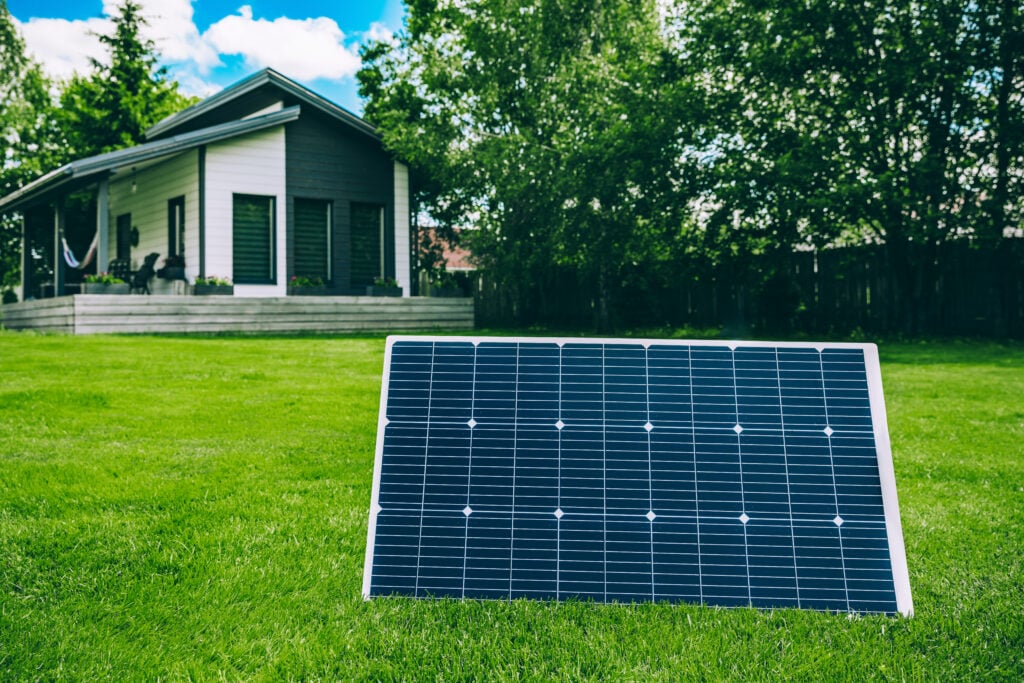
For most home-backup buyers, the panel’s job is simple and specific: live in a bag until the grid goes down, come out for a few days, do the work, go back in the bag. What makes a panel right for that pattern is the ability to deploy exactly the watts the outage demands — one panel for a light day, four for a heavy one — without a fixed installation, a heavy lift, or a second person needed.
The case for this panel is the case for incremental scalability — no other panel in this comparison matches it. Grab one panel for a light outage; grab four and you have a 525–537W array through one XT60 connection into a compatible EcoFlow station. Scale all the way to eight panels and you’re looking at close to 1,000W. That flexibility is the whole argument: you deploy the watts the situation calls for, not the watts that happened to fit in one housing.
It also hits its rating. Independent testing puts single-panel output at 110–112W under good sun, and a four-panel set at 525–537W with peaks at 556W — numbers that match or beat the label. TOPCon cells hold meaningful output as clouds thicken, which matters when a stowed-kit outage turns into a grey-sky one. The 5-year warranty and a 30-year-to-90%-output lifespan claim are real durability points for a kit you’re buying today and relying on across years of outages.
Owner accounts reinforce the use case directly — one documented build puts ten panels across two large stations for a household disaster kit, covering fridge, freezer, and critical loads, with panels bagged between outages.
Two things to respect before you set it up. The build is light, which is the source of its portability — and also means wind will tip it; sandbag or stake it any time it’s unattended. The tempered glass can take weather but not a fall. The interconnect pigtails are short, so if you’re sun-tracking across a large array you’ll want XT60i extension cables.
One hard system note: the 50V open-circuit voltage exceeds the input ceiling on smaller EcoFlow stations (like the River series) and many non-EcoFlow stations — the Anker C300‘s 28V ceiling is one example. This panel is a native fit for mid-to-large EcoFlow stations. Outside that ecosystem, an external MPPT is required and the plug-and-play advantage disappears.
On bifacial output: the rear-side gain is real only over reflective ground — independent testing puts it at roughly 52% of the spec boost on grass. For a yard deploy, plan on front-side output and treat the bifacial number as upside, not the floor.
Skip it if: you own an Anker station and want max watts through a single connection — the Anker SOLIX PS400 is the better fit there, and it’s proven in heavy rain.
The PS400 is the right answer for the buyer who wants maximum watts through a single connection and fewer pieces to manage during a deployment. At 275–345W under good sun — roughly equivalent to two smaller panels in one housing — it leads on single-panel output in this tier, and its IP67 rating has been validated in heavy rain and sustained off-grid use by owners. It connects natively to Anker stations via MC4 (with an adapter to XT60 for others), which simplifies the Anker-ecosystem setup considerably.
It’s the runner-up rather than the pick for two reasons. At 35.3 lb, it’s a genuine two-person deploy — the modular’s grab-the-panels-you-need flexibility and sub-10-lb-per-panel handling simply don’t exist here. And the snap-button angle stand is a documented failure point that owners report as unreliable; anchor or externally support it, because there is no reliable fix from the manufacturer. For a panel that comes out during stressful outage conditions, a stand you can’t trust is a real problem.
If your stations are Anker, your outages are manageable with one heavy panel, and you want the simplicity of a single-connection deploy with a proven rain-proof build, the PS400 earns its place. The incremental scalability is gone, and so is one-person handling — that’s the trade.
A permanent or semi-permanent yard array asks different things of a panel than a closet kit does. It needs to produce sustained, meaningful output day after day rather than peak output during a short deployment window — and it has to survive whatever weather shows up, because you’re not retrieving it when a storm rolls in. The flat-deploy trap that makes some large panels disappointing for campsite use stops being a trap here, because a fence, pole, or ground stand solves it permanently.
The 500X is the highest single-panel output pick on this page — and a permanent tilt-mount is precisely the setup that unlocks it. Laid flat, it delivers around 250W; mounted at 20–30° on a fence or ground stand, independent testing and Jackery’s own support documentation put the realistic output ceiling at 70–80% of rated, landing around 350–400W. That’s the panel this buyer needs: enough output to meaningfully replenish a large or whole-home station through a daylight cycle, from a fixed point that never needs to be set up again.
At 22 lb it’s the lightest large panel in this comparison — considerably lighter than the 400W foldables — which matters when you’re siting and aiming it on a permanent structure. TOPCon bifacial cells and IP68 weatherproofing mean it can stay out through weather without retrieval, and the bifacial sub-panels keep producing when partial shade drifts across the array.
Jackery explicitly positions it for their large stations — the 5000 Plus, 3000 Pro, HomePower 3600 Plus — and the output tier matches: a 400W tilt-mounted panel can make a real dent in a multi-kilowatt battery across a day.
Two planning notes. Jackery’s support quotes a 70–80% realistic ceiling even under ideal conditions — plan around 350–400W tilted, not 500W, when sizing what the array will actually deliver. And the warranty cautions against third-party extension cables, which matters if the station is far from the mount point; site accordingly.
Skip it if: you need a panel that stores and deploys in minutes without a fixed mount — the EcoFlow 125W Modular is the stowed-kit answer, scalable from one panel to eight.
The same panel that wins the stowed-kit segment earns a runner-up here for a different role: a scalable, relocatable ground array that’s always-on in spirit if not always-fixed in structure. It hits its rating, its TOPCon cells hold output under variable cloud, and the 30-year-to-90%-output lifespan claim makes it a credible long-term investment for a permanent-ish setup. Scaled to 1,000W across eight panels, it can match or exceed the 500X’s total array output.
It’s the runner-up rather than the winner because it’s not a true fixed installation. The light build catches wind and tips without anchoring, and there are no mounting feet — semi-permanent at best, not something you bolt to a fence and forget. The 50V Voc gate also keeps it inside the EcoFlow ecosystem without external hardware. For the buyer whose ‘always-on’ setup is better described as ‘frequently deployed in a consistent spot,’ it’s the more flexible answer.
A note on the EcoFlow 400W: peaks at 300–360W under good sun, but the polymer surface degrades 25–50% under sustained UV and heat within one to two years. For a stowed-deploy kit it’s a viable option; for a panel living outdoors year-round it’s the wrong choice.
The cruellest irony in home-backup solar is this: the outage most likely to last multiple days is the one caused by the storm that’s also blocking the sun. For a buyer in a hurricane corridor, a Pacific Northwest rain season, or anywhere that multi-day overcast is the normal backdrop for a grid failure, the standard benchmark — sunny-day watts — is nearly irrelevant. What decides this segment is what the panel produces when the sky is grey and stays grey.
Under grey skies, this panel holds output that most others lose almost entirely. Independent testing under simulated cloud cover put it among the strongest low-light performers in the category: 48W through bright cloud, 27–28W under heavy overcast, 13W in deep shade. Those aren’t headline numbers — but when a standard 400W foldable might be delivering 20–30W under the same sky, the per-panel edge compounds meaningfully across a multi-panel storm array.
The owner accounts make the use case explicit. One documented storm build — eight days without power through a hurricane — was designed specifically around this panel’s cloudy yield, keeping essential loads charged when the sun barely appeared across the full outage duration. That’s the scenario this panel was bought for, and it delivered.
Fast two-fold setup matters here too: deploying in deteriorating weather is not the time to wrestle with a complex stand. The 5-year warranty and documented clean performance through 150 fold-cycles mean the kit you buy today will still be ready for the storm five years from now.
Two things to plan around before building a storm array on this panel. The IP68 rating covers the panel face — Jackery’s manual explicitly warns against water exposure at the connection ports, so keep those dry and covered. And at 100W per panel, home-backup loads require running several in parallel; factor the proprietary DC8020 connector into your wiring plan, because it ties you to the Jackery ecosystem and makes cross-brand expansion harder than it looks.
Skip it if: you’d rather oversize a scalable array to brute-force through cloud cover than optimize per-panel cloudy yield — the EcoFlow 125W Modular scales to 1,000W and its TOPCon cells hold meaningful output as the sky thickens, so even 30% grey-day efficiency still delivers substantial watts to essentials.
This panel’s third distinct role on the page is its answer to storm-season backup: scale your way through the clouds. One head-to-head test in heavy overcast showed a 67% output advantage for the 125W Modular’s TOPCon cells over the older EcoFlow 400W foldable — a meaningful margin when cloud cover is the permanent condition. Run it at 1,000W array capacity and 30% grey-day yield still delivers roughly 300W to essential loads. That’s a different strategy than chasing the best per-panel cloudy output, but for a buyer who already owns or plans the modular array, it works.
It’s the runner-up rather than the pick because the Jackery 100W’s per-panel cloudy performance is better-documented and purpose-matched to multi-day storm backup, and because the 50V Voc gate means the modular array stays EcoFlow-only without external hardware. The choice between them is a choice between strategies: optimize the panel or oversize the array.
Picks on this page come from deciding what the use case actually rewards — then judging each unit by how it behaves under those conditions, not by how it reads on a spec sheet. The criteria that matter shift with the job, so a unit that’s decisive in one segment can be disqualified in the next by a single behavior. Where two contenders cleared the same bar, documented performance under real load settled the pick, not a comparison of rated numbers.
Three things decide whether a solar panel is actually useful for home backup — and only one of them is on the box.
The first is real output at your actual conditions. Rated watts are a lab ceiling; what matters is what the panel delivers into a large station on a typical deploy day, a tilted permanent mount, or a cloudy afternoon during a storm. Real-world figures — from independent testing and documented owner use under named conditions — anchor every verdict here. Panels that can’t hit a meaningful fraction of their rating under the conditions their segment demands were passed over regardless of nameplate.
The second is weatherproofing and durability. An outage panel that can’t be trusted in the weather that causes outages has a fundamental problem. IP rating, validated rain performance, and the long-term surface durability that determines whether a panel still delivers years from now all factored in — with particular weight for any panel intended to live outdoors permanently.
The third is system fit. High-output panels can carry open-circuit voltages that trip smaller stations into overload or simply produce no charge. Two panels in this guide carry voltages that rule them out for smaller stations entirely — that hard constraint is enforced per segment and called out wherever those panels appear.
Scalability and connector ecosystem round out the picture: a backup kit you can size up or down to match the outage, and wiring that actually connects to the station you own, both matter in ways that raw wattage rankings hide.
Panels better suited to recreational or van-life use than to home-backup replenishment of large stations were set aside early. One panel with documented long-term UV degradation that eliminates it from permanent outdoor use is addressed in the body where it’s relevant. Every recommended panel is argued in its own section; the deciding evidence lives there.
The picks above answer “which one for my situation.” This table answers “show me everything, I’ll decide.” It lays every unit out on the same axes used to make the calls — measured behavior, not nameplate specs — so a reader whose priorities cross segments can weigh the tradeoffs directly instead of trusting our segmentation.
| Panel | Rated Output | Real-World Output | Weight | Weather Rating | Warranty | Price | $/W | Buy |
|---|---|---|---|---|---|---|---|---|
| EcoFlow 125W Bifacial Modular | 125W (138W bifacial) | ~110–112W single; ~525–537W per 4-panel set (good sun) | 9.26 lb each | IP68 | 5 years | $249 | $1.99/W | Check price |
| Anker SOLIX PS400 | 400W | ~275–345W good sun; ~170–195W winter/haze | 35.3 lb | IP67 | — | $699.99 | $1.75/W | Check price |
| Jackery SolarSaga 500X | 500W | ~250W flat; ~400W tilt-mounted | 22.05 lb | IP68 | 5 years | $799 | $1.60/W | Check price |
| Jackery SolarSaga 100W | 100W | ~57–80W good sun; ~48W bright-cloudy; ~27–28W heavy overcast | 7.94 lb | IP68 (face only) | 5 years | $199 | $1.99/W | Check price |
— = not independently verified for this guide
The questions here are the ones that don’t belong to any single pick — the cross-cutting concerns that come up regardless of which unit a reader lands on. We pulled them out of the individual segments so each answer lives in one place, addressed against the same standard of evidence used throughout the page.
The same panel plays three genuinely different roles depending on how you use it. In the stowed-kit segment it wins on incremental scalability — grab one panel for a light outage, grab four for a heavy one, deploy in minutes, pack it away. In the always-on segment it’s the runner-up as a relocatable ground array, with a 30-year-to-90%-output lifespan claim that makes it viable for semi-permanent outdoor use, though it can’t be truly fixed the way the SolarSaga 500X can on a fence or pole mount. In the storm-resilient segment it’s again the runner-up as an oversizing strategy — its TOPCon cells hold meaningful output under thickening clouds, and scaled to 1,000W, even 30% grey-day efficiency still delivers substantial watts. The one consistent constraint across all three is the 50V open-circuit voltage, which keeps it inside the EcoFlow ecosystem on mid-to-large stations without an external charge controller.
Two panels here are hard stops for smaller stations. The EcoFlow 125W Modular carries a 50V open-circuit voltage and the Bluetti PV350 carries 46.5V Voc — both exceed the input ceilings of most small stations (many cap around 28V), which means the station either trips into overload or simply produces no charge. Those two are mid-to-large station picks only. The Jackery SolarSaga 100W and 500X use the proprietary DC8020 connector and are sized for Jackery’s own station lineup; the 100W in particular is compact enough to pair with a smaller Jackery station, though home-backup loads will demand multiple panels in parallel. The Anker SOLIX PS400 connects via MC4 natively and is more flexible on input compatibility, but at 275–345W under good sun it can easily exceed what a small station’s MPPT can absorb — check your station’s solar input ceiling before connecting.
Rated watts are a lab measurement at standard test conditions: 1,000 W/m² of irradiance, a specific cell temperature, a specific spectrum. A panel mounted on a fence in a real yard sees variable irradiance, higher cell temperatures in summer, and a sun angle that’s rarely perfect. Jackery’s own support documentation quotes a 70–80% realistic output ceiling even under ideal conditions for the 500X, which puts the practical planning number at 350–400W tilted — not 500W. The tilt-mount is what bridges the gap between the ~250W it delivers laid flat and that 350–400W figure; without a fixed mount angle, you’d be planning around the lower number. For sizing how much of a large station the panel refills per day, 350–400W under good sun is the honest working figure.
A bigger panel produces more watts when the sun is out, but under heavy overcast most panels — large and small — collapse toward a fraction of their rated output. The question is what fraction. The Jackery SolarSaga 100W delivers 27–28W under heavy overcast and 48W through bright cloud, figures that independent testing ranks among the strongest low-light performers in this comparison. A larger panel with weaker cell technology might produce a similar or lower absolute number under the same sky despite having a much bigger rating. Two strategies address storm backup: optimize per-panel cloudy yield (the Jackery 100W’s approach) or oversize the array so that even a modest percentage of rated output adds up to useful watts (the EcoFlow 125W Modular’s approach, scaled to 1,000W). Both work; which fits you depends on whether you’d rather run fewer high-yield panels or more panels in a scalable array.
IP67 means it’s rated for temporary immersion up to one meter, and owners have validated the rating in heavy rain during sustained off-grid use — it’s a legitimately rain-proof panel, not just a paper IP rating. The caveat is the snap-button angle stand, which is a documented failure point independent of the waterproofing. The panel itself handles rain; the stand may not hold angle reliably under real-world conditions. Anchor or externally support it whenever it’s deployed, especially in the wind that accompanies most storm outages. The three picks carry IP68, and the SolarSaga 100W‘s IP68 covers the panel face only — its connection ports need to be kept dry per Jackery’s manual, a real consideration in storm conditions.
If you keep panels in a closet and want to deploy exactly what the outage demands — no more, no less — the EcoFlow 125W Bifacial Modular is the default choice for EcoFlow-ecosystem owners: it hits its rating, scales from one panel to eight, and weighs under 10 lb each. For an Anker setup where single-connection max output matters more than incremental flexibility, the SOLIX PS400 earns the nod with its rain-proven build and strong single-panel numbers, offset by a stand you need to anchor and a two-person carry.
If the panel is going on a permanent mount, the Jackery SolarSaga 500X is purpose-built for it: the tilt-mount that’s inconvenient for a stowed kit is exactly what unlocks its ~400W real-world output, and at 22 lb it’s easier to site than anything else in this output tier. And if your outages come with the storm — multi-day overcast, not blue sky — the Jackery SolarSaga 100W wins on the axis that actually matters: 27–28W under heavy overcast and 48W through bright cloud, figures that hold up when other panels have little to offer. The same panel that looks modest on a sunny-day spec sheet keeps essentials running across an eight-day storm outage. That is the whole argument for it.