
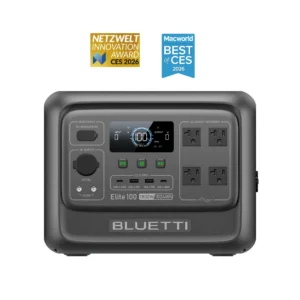
The most common home-backup scenario — grid drops, you’re home, and you want the refrigerator, router, lights, and phones to keep running for hours to a day without an electrician or a transfer switch. Plug the important things in and trust the box.
The spec sheet points one direction; the lived-outage evidence points another. On paper, the AC180P is the better value at $0.35/Wh with an 1,800 W inverter that clears a fridge comfortably. The thing that cleared the field was a documented behavior: on a surge or non-uniform grid disconnect, it can lock out AC output entirely and stay dark until someone manually power-cycles it. That is exactly the failure this buyer cannot afford mid-outage, and no firmware update has addressed it. The Elite 200 V2‘s UPS story is the opposite — validated through real outages and home-lab grid drops with the outlets staying live.
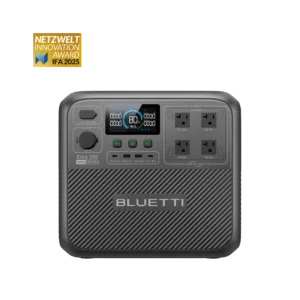
This is the strongest inverter in Bluetti’s portable line at 2,600 W, and ~1,990 Wh reaches the AC outlets after inverter losses and idle draw — a figure derived from bench-measured 96% inverter efficiency and a 9.5–10 W idle. That translates to a full-size fridge running 22–30 hours on a single charge. The 15 ms switchover keeps desktops, modems, routers, and servers alive through grid drops without a reboot, and the ~1.5-hr Turbo recharge means a short grid window or a generator run turns into a full reset. One owner runs it as UPS for a treadmill used by an MS patient where an unexpected stop is a fall risk — that is the trust level this segment requires, and it’s trust the alternatives here don’t earn.
Three things to configure before you rely on it. First, ECO mode ships on and auto-cuts the inverter at very low AC loads — it came close to killing one owner’s reptile life-support setup, so disable it. Second, the display reads apparent power (VA), which runs roughly double the actual wattage on some loads; run a full charge/discharge/recharge calibration so the gauge and runtime estimate are honest. Third, the 15 ms switchover covers the vast majority of AC-connected gear, but one owner’s specific PC power supply found it too slow — it works for most, not guaranteed for every sensitive PSU.
Not expandable. 2,073.6 Wh is the ceiling, and that’s a real constraint for outages measured in days rather than hours.
Skip it if: your outages stretch past a day, or you want a battery that can grow — the Elite 400 (multi-day segment) is the right unit, and if $799 is the budget ceiling, the AC180P below covers attended daytime use at a meaningful discount.
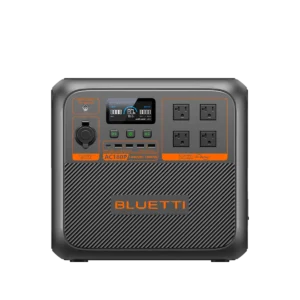
At $499 the AC180P is the strongest value in this segment for a buyer who will be present during outages. Independent testing puts usable capacity at roughly 1,150 Wh at the AC outlets after losses and the ~15 W idle, which runs a full-size fridge 10–12 hours or a CPAP through a long night. The 1,800 W inverter handles microwaves and coffee makers, and stacking a second unit is how satisfied owners scale up.
The constraint that costs it the top spot: the UPS lockout described above is a structural behavior, not a configuration issue, and cascading a traditional UPS behind it doesn’t help because the lockout defeats the bridge. Treat it as a battery you plug the fridge into when you’re standing next to it, not as an automatic overnight protector. Also worth knowing: the marketed expandability to 4,224 Wh does not exist — Bluetti’s own manual confirms no capacity expansion for this unit, only a Power Bank Mode.
Two units in this segment that don’t make it this far: the AC180 shares the AC180P’s enclosure and output at $200 more with 288 fewer Wh — there’s no axis where that math wins. The AC240P at $1,999 costs nearly 4× the runner-up for 400 Wh less than the pick, and its IP rating solves no indoor problem.
When outages are measured in days, the question is simple: how many usable watt-hours do you get, and can you move the thing? Duration is the whole game, so the segment resolves on measured usable energy per dollar — and the Elite 400 owns that axis with daylight.
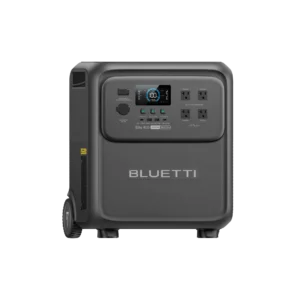
Independent testing measured ~3,576 Wh usable at a 1,500 W AC draw — 93% of nameplate, exactly the kind of load this segment runs. That works out to roughly $0.36 per usable watt-hour, a figure the rest of the catalog can’t match. The nearest 120 V alternatives — the Elite 300 at ~2,800 measured usable Wh for $1,649, and the Apex 300 at ~2,400 usable Wh for $1,699 — both give up significant energy for more money. The 2,600 W inverter matches the strongest portable in the lineup and adds 200 W over the Elite 300. The wheeled chassis, compared by reviewers repeatedly to rolling luggage, is how an 86-lb battery stays livable in a house — one person can move it horizontally without help.
Independent testing anchors the real-world picture: fridge plus TV plus router plus lights plus two phones plus a space heater through a 10-hour outage with roughly 20% remaining; a furnace alone for 24 hours with about 40% left. Inverter-on idle runs 9–20 W depending on mode (the marketed 3 W figure is a deep-standby state, not inverter-on operation) — still class-leading, and that low drain directly buys extra fridge-days.
A few things that matter before you buy. The 2,600 W ceiling is firm — owners document a 2,000 W base load running fine, then tripping the moment a kettle was added on top; sequence your heavy loads deliberately. Wheels handle horizontal movement only; Bluetti recommends three people for any lift, so if your storage plan involves stairs, work that out before delivery day. Solar is a secondary feature at best — the battery is far larger than the input can sensibly serve. The app and WiFi are a documented weak point; don’t build remote monitoring into your outage plan. It carries the UL 2743 label advising against use in sleeping rooms — relevant for anyone planning a bedside installation. ECO mode off for any low-draw or medical load.
Skip it if: you need 240V circuits or want a battery that grows — the Apex 300 in the next segment is the only path to either, and no amount of Elite 400s on a single install delivers split-phase power.
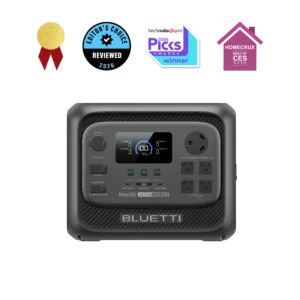
The Elite 300 earns its runner-up slot on two narrow but real conditions. It’s the only unit in this segment with a NEMA TT-30 outlet — independent testing confirms it routes cleanly through a TT-30 transfer switch to back up an essential circuit. And its measured switchover sits at 8.1–8.9 ms, fast enough that a desktop survived a cutover mid-benchmark; that’s the fastest verified figure among Bluetti’s 120 V units. If either of those conditions matches your install, the Elite 300 is the right unit.
Outside those cases, the value math is hard to ignore: roughly 800 fewer usable watt-hours than the pick for $350 more, with a smaller 2,400 W inverter. Its DC idle is genuinely impressive — sub-4 W, good for roughly month-long standby — but AC recharge requires a dedicated 20 A circuit via an app unlock to reach the faster time; on a standard 15 A outlet, plan nearly 2 hours 45 minutes. Fan noise at 50–53 dB under load is irrelevant in a utility room, worth noting for any bedroom-adjacent placement.
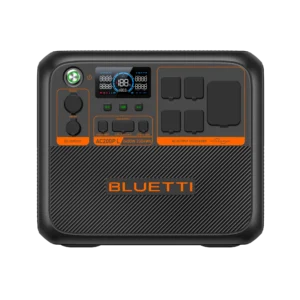
The AC200P L loses the segment’s central axis badly — independent testing places it at roughly $0.91 per usable watt-hour against the Elite 400’s $0.36 — but it’s the only 120 V unit on this page whose capacity isn’t a ceiling. Two B300 expansion batteries push it to 8,448 Wh; a field-confirmed build reached approximately 5 kWh. The buyer who wants roughly 2 kWh today and a path to 5–8 kWh as budget allows buys this, not the sealed Elites.
One flag that matters specifically for a backup unit kept in storage: the mains charging cable uses a proprietary 3-pin connector with no commodity replacement and one documented early failure. Source a spare before you need it. Keep backup loads on AC — the DC output path runs at only 72% efficiency. For 240V growth, it can’t help; that answer is Segment 3.
This segment starts where the others stop: you’re not unboxing, you’re installing. A transfer switch on essential circuits — well pump, furnace, fridge, bedrooms — possibly 240V loads, and a system you expect to grow. The central requirement is split-phase 240V output, and that’s a physical capability the hardware either has or doesn’t.
Exactly one Bluetti has it. Every other unit on this page is 120V-only and cannot be wired into a 240V circuit regardless of inverter size or capacity. The field reduces to one candidate before value or output enters the conversation.
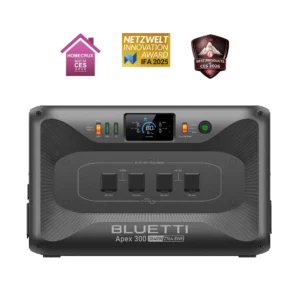
The headline feature is exactly what it sounds like — simultaneous 120V and 240V from a single chassis while charging from a standard 120V outlet. Independent testing confirmed 3,800 W sustained for five minutes; owners running two 15,000 BTU RV air conditioners plus a heater report it holding. The prior generation of split-phase Bluetti setups required fusion boxes or paired units; the Apex 300 handles it in one box, and independent testing names that as ‘the single most-cited reason to choose it.’ The validated deployment is exactly this segment: wired to a transfer switch on essential circuits, grown over time as budget allows — base unit now, expansion batteries, a second unit, the SolarX 4K accessory later. Measured standby draw of 18–24.7 W is the relevant planning figure for a permanently sited unit.
Owner anchors at installed regimes: a cabin on lights and internet ran 5–7 days on the base battery; a full cabin load including a microwave drained it in about a day and a half. The base 2,764.8 Wh empties in roughly 41 minutes at the rated 3,840 W load — expansion batteries are the architecture, not an accessory.
The fine print that shapes every install deserves real attention. One unit delivers 240V at 16 A — a 30 A service needs two units and a 50 A service needs three; size the transfer switch plan before purchasing. The base unit ships with zero USB or DC ports (Hub D1 required; its combined output is just 120 W), no PV cable, and no turbo cable — budget the accessory list explicitly. The single expansion port can’t simultaneously accept a Hub D1 and a battery; the Hub chains through a battery’s second port, which surprises owners who try to add both at once. The 0 ms UPS is conditional on a specific outlet and breaker sequence at install; one owner needed to cut the unit’s feed breaker during outages to clear an error. Solar planning must account for the 60–150V dead zone: the built-in MPPT stops at 60V and the SolarX 4K starts at 150V, so arrays between those values use neither without rewiring. In 240V mode under light continuous loads, the pass-through draws 3–4× the consumed power from the grid while cycling the battery — confirmed by Bluetti as intentional behavior; the 18–24.7 W standby figure describes standby only, not inverter-on light-load operation.
No runner-up exists in this catalog — no other Bluetti produces 240V output. The buyer who wanted only the expansion capability from this segment, without the wiring, is served by the AC200P L in Segment 2.
Skip it if: you only need 120V plug-in backup and want maximum stored energy per dollar — the Elite 400 in Segment 2 delivers roughly 3,576 measured usable Wh for $400 less, with wheels and no accessory list.
Network gear, a NAS, a workstation, a modem — continuous low draw, and the only job that actually matters is that the outlets never blink, including at 2 AM when nobody’s watching. Switchover speed is the spec everyone quotes, but that’s not the hard part: every candidate in this segment is already fast enough for the hold-up time of a typical power supply. What actually separates them is whether the outlets stay live — through low-draw lulls, messy disconnects, and extended unattended operation.
The AC70 has an appealing spec sheet — 20 ms switchover, 768 Wh, $349 — and is vetoed for this job. Owners document 300W+ PCs rebooting despite the 20 ms spec, including a state-dependent failure mode that works while the unit is charging but fails when it reaches full charge. There is no setting that resolves it. The unit works fine protecting a router or modem; it just doesn’t belong under a desktop or a NAS that can’t afford a reboot.
Owner reports consistently name home and IT UPS as the Elite 100 V2’s most common use — networking racks, NAS boxes, home offices, and entertainment centers riding through outages with PCs and servers staying alive on the sub-10 ms switchover. It handles the workstation class of load that the AC70 can’t, and at the same $399, it delivers more than double the energy of the AC50B while covering every validated UPS mode.
Independent testing measured 869–910 Wh at mid loads. At the rack-class draws this segment actually runs, the more relevant figure is inverter-on standby drain — measured at roughly 262 Wh over 24 hours, or about 11 W of continuous overhead on top of whatever the load draws. A 50 W rack still bridges most of a day; just budget runtime with that idle term in the calculation, not from nameplate.
Out of the box it is not ready for drop-in deployment. Disable ECO mode first — the default cut off a sump pump’s outlets during its between-cycle idle despite correct UPS mode, resulting in a documented basement flood. Enable System Switch Recovery so AC output resumes automatically after grid restore. Even properly configured, there is an early-failure cluster in owner reports — DOA units and deaths within the first one to six months, warranty honored but real. For any unattended load whose failure means property damage or a health risk, this whole product class warrants a second line of defense, not just this unit.
Skip it if: the only thing you’re protecting is a router and a modem — the AC2A below does that job for $180 less with a smaller footprint and nothing you don’t need.
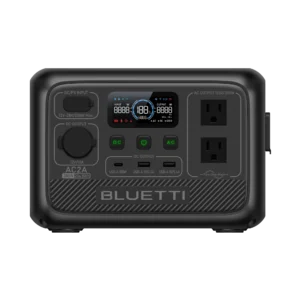
For a 24/7 fixture protecting network gear only, the AC2A is the cleaner fit. Independent testing measured its switchover faster than the 20 ms spec, and owners report mesh APs and cable modems surviving outage after outage without a reboot. A 20 W router-class load runs roughly 6–7 hours on battery; the AC inverter path runs at about 70% efficiency, so keep expectations sized to that.
It has a documented deep-discharge BMS lockout that has bricked units stored at low charge, requiring a recovery procedure using a cable not in the US box. The always-on, always-topped UPS role is the exact usage pattern that avoids that failure mode — the unit never sits at low charge because it’s always plugged in. Do not repurpose it for closet storage between emergencies; that is precisely the pattern that triggers the lockout.
128 Wh, 200 W, 10 ms switchover with a 350 W bypass, and roughly 5 hours on a 14 W modem load. Two setup steps before trusting it: ECO off and System Switch Recovery on — the latter is buried behind an unlabeled ‘Advanced Settings’ password of 8888. The fan can run in bypass even under sub-10 W AC loads; charge attached devices over USB-C to keep it silent, and don’t plan it as a bedside-quiet unit when running on AC. Its warranty is 3 years, shorter than the 5-year coverage on the rest of the Elite line.
Two units excluded from this segment on the merits: the AC70 is vetoed for desktop UPS duty as described above — the documented fix is cascading a dedicated traditional UPS behind it, which defeats the purchase entirely. The AC50B‘s manual explicitly disclaims UPS use, and owners discontinued always-on use after observing micro-cycling behavior at full charge in pass-through.
A significant share of home-backup buyers plan to charge a unit once and store it until they need it. Before purchasing anything on this page, that plan deserves a clear-eyed look.
No unit in this catalog is validated for charge-and-forget storage. Bluetti publishes no standby-retention figure for any SKU here — which means the answer to ‘how long can I leave it charged?’ is unknown, not reassuring. The evidence that does exist points the other direction: the AC2A‘s deep-discharge BMS lockout has made units useless at the exact moment of need, and recovery requires an undocumented trickle procedure using a cable that does not ship in the US box. The AC2P shows a recurring no-power pattern after idle storage.
The closest things to stored-readiness data are consumption figures — the Elite 400‘s measured inverter-on idle and the Apex 300‘s measured standby draw — but a consumption figure tells you how fast the battery depletes, not how long it holds a charge safely.
The practice every extended-use review converges on: keep the unit in the 40–60% storage band, recharge every 3–6 months, and test it on a schedule. If that maintenance routine isn’t realistic for how you’ll actually use this, no unit on this page changes the underlying risk.