When you purchase through links on our site, we may earn an affiliate commission. Learn more.

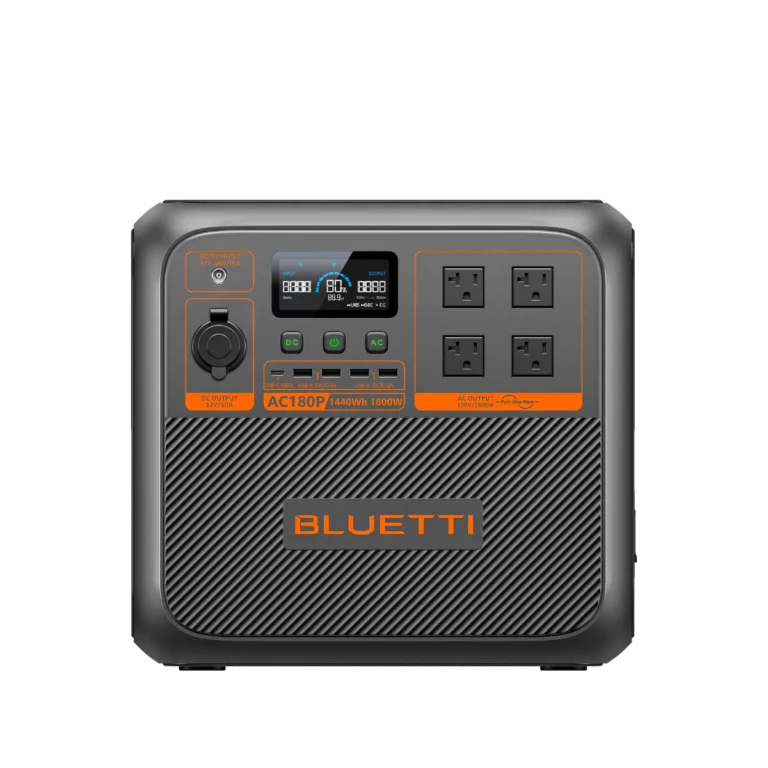
Bluetti AC180PvsEcoFlow DELTA 3 1500

Two near-identical 1.5kWh-class boxes on paper — same 1,800W inverter, same LiFePO4 chemistry, roughly 36 lb apiece, both 120V-only, both 5-year warranty. The spec sheets nearly tie. The reviews don’t. The AC180P is a focused value and portable unit with one disqualifying flaw for one buyer: its UPS locks out unattended. The DELTA 3 1500 is more versatile but compromised — quieter, expandable, and hands-off reliable, while it loses on price, charging behavior, and demonstrated heavy-load performance. The right pick is entirely a function of which buyer you are.

Check price
Prices and availability change frequently
Check price
Prices and availability change frequently
Spec Bluetti AC180P EcoFlow DELTA 3 1500
Capacity (Wh) 1,440 1,536
Rated output (W) 1,800 1,800
Surge (W) 2,7001 3,600
Weight (lbs) 35.3 36
Chemistry LiFePO4 LiFePO4
AC recharge (hrs) 1.42 1.5
Solar recharge (hrs) 3.6 (at 500W) ~3.5 (at 500W)
Solar input (W) 500 500
Port array 11 ports: 4× 120V AC, USB-A, USB-C, 12V DC, wireless pad AC outlets, USB-C 100W, USB-A (12W + 18W), DC5521 38W, 126W car
Price $499 $599
Price per Wh $0.347 $0.390

1 Power Lifting mode — resistive loads only, not motor-start; drops voltage and dims devices. 2 US-market figure only; UK and AU owners report capped charging speeds regardless of setting. A blank cell means we did not record that figure in our research, not that the feature is absent.

Carry it and you're there to run it

  • Who it’s for: The buyer who physically moves the unit and is on hand while it runs — drive-in camping, overlanding, RV, or running essentials through an outage they’re home for. This is the largest population for both products.
  • Value: $100 cheaper for roughly 94% of the capacity; lower cost per watt-hour.
  • Our review names this its strongest case. Camping, RV, and overlanding are the unit’s strongest case — one-handed carry at 35.3 lb with dual handles, owners running fridges, coffee makers, microwaves, and air-mattress pumps, roughly 20–25% of capacity drawn per day off-grid, and the wireless pad plus 11-port layout cited as camp-practical. A 400W solar array gives genuine multi-day off-grid power.
  • Faster top-offs between uses (US): 0–80% in 45 minutes, full in roughly 1 hour on Turbo — validated stateside in our review, and faster than the DELTA’s 60-min/90-min AC charge.
  • Combined charging works: The AC180P recharges from AC and solar simultaneously. The DELTA 3 1500 cannot — it cuts solar when AC charging starts under common Backup Reserve settings.
  • Usable energy at this load: AC180P delivers approximately 1,150 Wh at the AC outlets at appliance-level load (stated in our review; gap from roughly 10% reserve, inverter efficiency, and roughly 15W idle). Run the 12V cooler on the DC port to bypass the idle tax entirely.
  • Runner-up: EcoFlow DELTA 3 1500 — take it here only if you specifically want the +96 Wh and the option to expand later; you pay $100 more and accept slower charging and no combined AC+solar.

You won't be there to reset it

  • Who it’s for: The buyer treating the unit as unattended insurance — fridge, router, modem, or a CPAP it must bridge through outages while the buyer is asleep, at work, or away. Criticality is high; the operator is not present to intervene.
  • The DELTA’s UPS actually holds unattended. Our review reports the 15ms switchover holding desktops, routers, and entertainment gear through outages without reboots (one router buzzed during switchover but kept working). No lockout pattern. It is a viable essential-device UPS — not whole-home, but that’s not this buyer.
  • Slight capacity edge (1,536 vs 1,440 Wh) is a minor bonus on top of the decisive reliability difference.
  • The AC180P is disqualified here. Our review documents a structural UPS lockout: on a messy power transition (wall power surging or disconnecting non-uniformly), the unit reports an AC short and kills AC output until someone manually toggles it off and on. This is structural, not transient — putting a real UPS behind it doesn’t help. There is no firmware fix, only an undocumented manual workaround. Our review tells the CPAP buyer directly not to make it the sole backup for life-critical gear. A hands-off standby buyer hits this flaw by definition.

It sleeps where you sleep

  • Who it’s for: Anyone whose unit runs where people sleep — a tent, a van build, a bedroom during an outage. Low noise becomes a weighted axis confirmed in our review.
  • DELTA runs near-silent at exactly this load. Owners of both EcoFlow generations describe it as nearly silent; variable-speed cooling holds a fridge at 50–150W dead silent and cool without the fan engaging, even handling a 550W compressor inrush. The generational fan improvement is the explicit reason our review endorses it for 24/7 essential backup.
  • AC180P’s fan triggers early — by design. Our review notes the extra battery cell (the source of its capacity-to-size advantage) reduces thermal headroom, so fans start around 200W, earlier than the sibling AC180. Bluetti confirms this is normal operation. Our review flags it specifically for bedroom or quiet-camp use. This is the same density that wins the AC180P its capacity-to-weight crown working against it here — the flipping axis is fan noise.

You run heavy appliances and tools

  • Who it’s for: The buyer who runs near-the-ceiling loads — 1,500–2,000W microwaves, kettles, coffee makers, hair dryers, pressure washers, shop tools. Sustained and surge output are weighted; an over-rated load is a near-disqualifier.
  • AC180P’s heavy-load performance is confirmed across a wide range in our review: Owners and testers ran 1,500W space heaters, 2,000W microwaves, 1,800W coffee makers, a roughly 1,589W leaf blower, and a roughly 2,100W combined pressure-washer setup; one owner runs a vacuum plus air compressor plus pressure washer daily for an auto-detailing business off it. Power Lifting reaches 2,700W for resistive loads (with the caveat that it dims connected devices and isn’t for AC units or washing machines).
  • The DELTA’s review caps the same territory. It states the 1,800W ceiling rules out full-size space heaters, window AC units, and heavy power tools — that’s a hard cap, not a soft one — and the 2,200W X-Boost claim is unvalidated anywhere in our review. The 3,600W surge is momentary inrush headroom, not continuous capability.
  • Caveat for genuine motor-start inrush specifically: The DELTA’s stated 3,600W surge is the higher rated figure, and the AC180P’s true passive surge isn’t separately specced (its 2,700W is resistive-only Power Lifting). But our review shows the AC180P starting compressors and pressure washers in practice. If your over-ceiling need is a large motor with a documented hard inrush spec, verify against the load directly.
  • Runner-up: EcoFlow DELTA 3 1500 — demoted here because its own review caps practical use at 1,800W and leaves X-Boost’s 2,200W claim unvalidated.

You want to grow capacity later

  • Who it’s for: The buyer who wants to start at roughly 1.5kWh and add capacity later without rebuying — a growing off-grid setup or a backup plan that scales.
  • DELTA expands to 5,500 Wh via the DELTA 3 Extra Battery — strong for this price tier.
  • The AC180P does not expand. Full stop. Bluetti markets capacity grows as needed to 4,224 Wh via B80/B230/B300, but Bluetti’s own manual and FAQ state the AC180P does not support capacity expansion — those batteries can only charge it through Power Bank Mode, adding no integrated runtime. Our review is blunt: ignore the marketing and don’t build a growth plan around it. The marketed 4,224 Wh figure is not credited. The way to scale the AC180P is to buy a second one and stack them.
The bottom line

Buy the AC180P if you’ll carry it and be there to run it — it’s cheaper, charges faster stateside, and our review backs it for camping and heavy appliances. Buy the DELTA 3 1500 if it has to work without you (standby UPS with no lockout), run where you sleep (quiet variable-speed cooling), or grow later (expandable to 5,500 Wh). Their spec sheets tie; our reviews decide, and they decide differently for different buyers. The AC180P wins on value, US recharge speed, and validated heavy-load performance across camping, RV, and tool use. The DELTA wins on hands-off reliability, quiet operation, and expansion headroom. The same trait flips sign across buyers: the AC180P’s extra battery cell wins it capacity-to-weight and validated heavy loads but costs it fan-quiet; the DELTA’s DELTA-2-generation internals give it the proven, lockout-free UPS and quiet fan but come with slower charging and broken combined AC+solar charging.