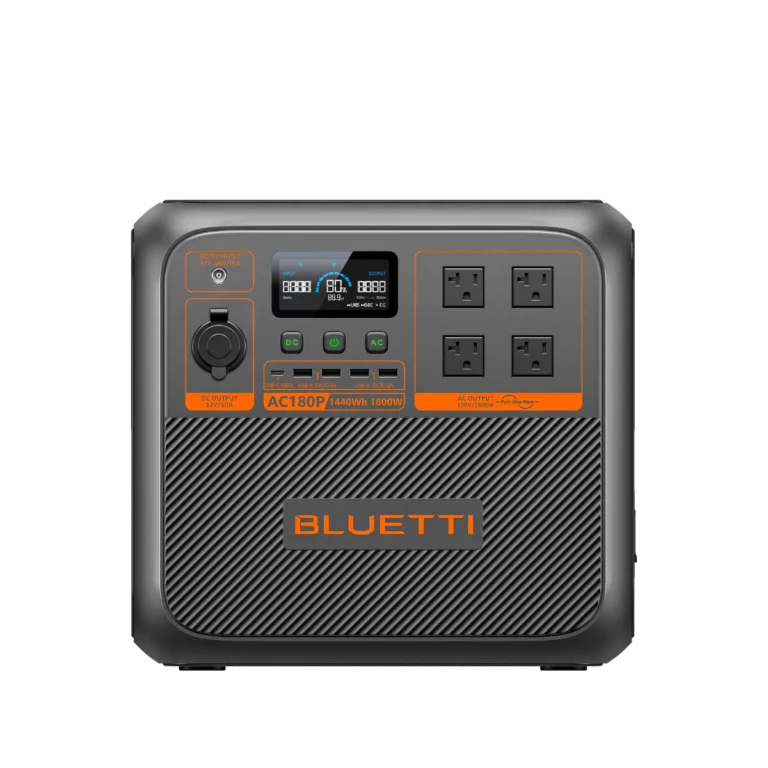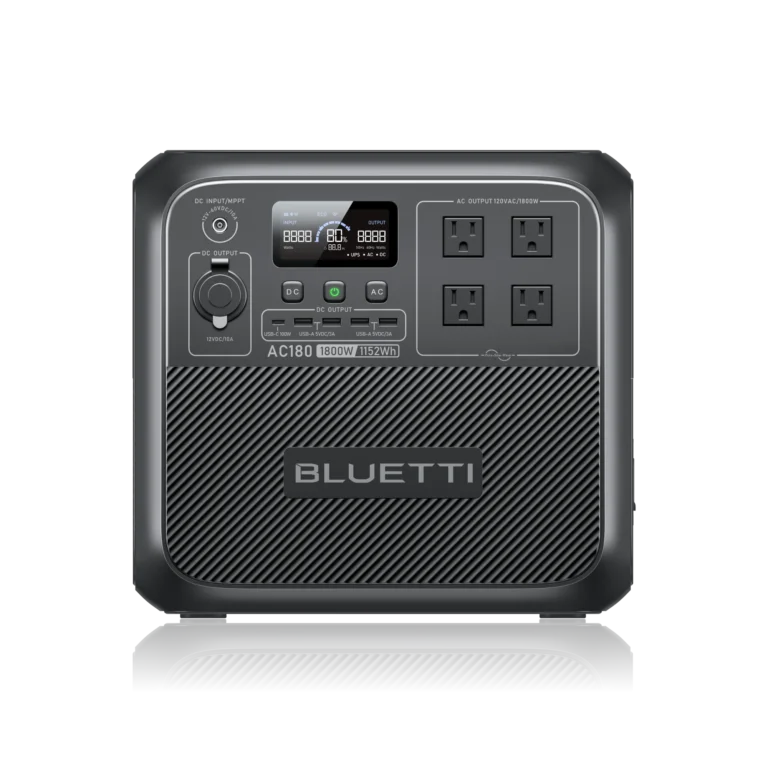
These aren’t two different power stations — they’re the same 35.3-lb box with different battery capacity inside. Identical 1,800W inverter (2,700W Power Lifting, resistive loads only), identical 11-port layout, identical 500W solar input, identical LiFePO4 chemistry, 5-year warranty, and 20ms UPS rating. They split on capacity and price, and on two things the spec sheet can’t show: how early the fans spin up, and whether the UPS will hold critical gear through a messy outage without you there to reset it. The AC180P is the default — more capacity, lower canonical price — unless you’ll sleep right next to it or need it to babysit backup loads unattended, where the AC180’s quieter fans and dependable UPS take over.
| Spec | Bluetti AC180P | Bluetti AC180 |
|---|---|---|
| Capacity | 1,440 Wh | 1,152 Wh |
| Rated output | 1,800W | 1,800W |
| Surge | 2,700W* | 2,700W* |
| Weight | 35.3 lbs | 35.27 lbs |
| Chemistry | LiFePO4 | LiFePO4 |
| AC recharge | ~1.4 hr (~45 min to 80%, Turbo) | ~1.55 hr (~45 min to 80%, Turbo) |
| Solar recharge | ~3.6 hr | ~3.05 hr |
| Ports | 11 (4× 120V AC, 1× USB-C 100W, 4× USB-A, 1× 12V/10A car, 1× 15W wireless pad) | 11 (4× 120V/15A AC, 1× USB-C 100W, 4× USB-A, 1× 12V/10A car, 1× 15W wireless pad) |
| Solar input | 500W† | 500W (10A / 12–60V) |
| Price | $499 | $699 |
| Price per Wh | $0.347/Wh | $0.607/Wh |
* Power Lifting mode, resistive loads only — not effective for motor-start inrush.
† AC180P solar input: real-world peaks ~250–485W on a 10A / 12–60V window.
True of both units — Hard limitation on both units — motor-start inrush: Neither unit reliably starts high-inrush motor loads. The 2,700W figure is resistive-only Power Lifting; our AC180 review documents an oil furnace tripping at 2,000W on motor start and an 1,800W log splitter triggering immediate overload, and the shared inverter means this applies to both siblings. If your backup plan includes a furnace blower, sump pump, well pump, or an old-compressor fridge, test it first — and don’t count on either unit’s surge number for anything with a startup spike.
The AC180P is the default for most buyers — more usable energy per dollar and per pound in the same box, best for camping, off-grid, RV daytime, and general standby where you’re around the unit in daylight. The AC180 costs more and holds less, but it earns its keep in two specific niches: when you’ll sleep right next to it (tent, RV bedroom, nightstand backup), where it stays silent longer and its fans ramp later than the AC180P’s approximately 200W trigger; and when you need it to babysit a fridge, CPAP, or network through outages while you’re asleep or not home, where its UPS holds unattended without the AC180P’s structural lockout. The capacity advantage is real across all three segments; it simply stops being the deciding axis once quiet or unattended-UPS reliability is what’s weighted. The entire value verdict hinges on the canonical price ($499 AC180P versus $699 AC180) — if street parity inverts, the Segment 1 default reasoning inverts with it.