
On this page
Here is the thing most buying guides skip: the “watt-hours” printed on a power station is not the energy you get — it’s the energy stored. Tested units delivered 92–97% of their rated capacity to actual devices, and that’s before surge overhead, cold temperatures, and inverter losses take their cut. Meanwhile, a generator’s runtime claim works the opposite fiction: the hours on the box assume you’re running it at half-load. Run it hard and those hours can collapse. Neither device is dishonest, exactly — but both specs are built on conditions that don’t match a real campsite.
The more fundamental question, though, isn’t watt-hours at all. It’s carbon monoxide. That single fact restructures the whole comparison for camping — and it’s where we’ll start.
The Safety Split That Changes Everything
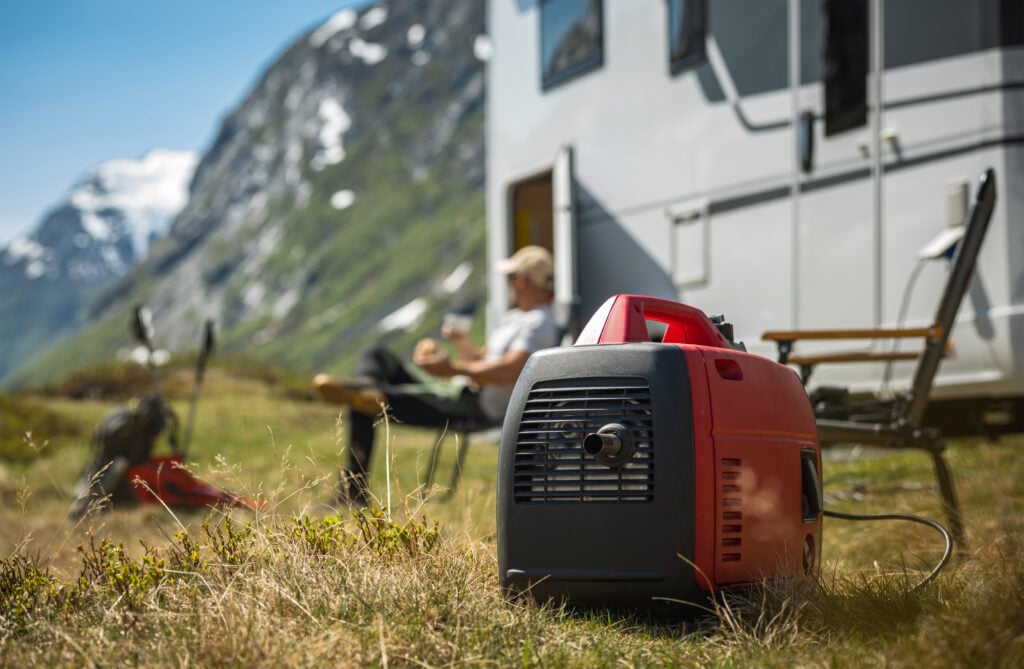
Generators burn fuel and produce carbon monoxide. CO is colorless and odorless — you cannot smell it, see it, or sense it until you’re already in trouble. The rule isn’t a precaution: run a generator at least 20 feet from any door, window, or vent, and never inside or even partially inside a tent, camper, RV, garage, or enclosed canopy. People die running generators “just for a few minutes” in spaces that feel open enough. Wind can push exhaust back toward a sleeping area even at distance.
Power stations produce no exhaust. You can run one inside a tent, inside a camper with the windows closed, at the foot of your sleeping bag. This is the single strongest argument for a power station in a camping context, and it isn’t close.
If your setup is an RV with roof venting, a well-positioned outdoor hookup, and a generator you’ll never bring inside — great. But if your camping involves tents, small trailers, or any enclosed space, the generator’s CO risk is a hard constraint, not a tradeoff to weigh.
What Each One Actually Is
A power station is a battery — now almost always lithium iron phosphate (LiFePO4) — with a built-in inverter. It stores a fixed amount of energy and delivers it silently, with no fumes. When it’s empty, you recharge it from a wall outlet, solar panels, your car, or a generator.
A generator burns gas, propane, or natural gas and produces electricity continuously as long as fuel is available. It never “runs out” in the field as long as you can get more fuel — which is also its defining advantage for extended stays.
That asymmetry is the core of the comparison. A power station’s energy is finite per charge; a generator’s is theoretically unlimited. Everything else — noise, weight, wattage, runtime — flows from that.
How Much Power You Can Actually Pull
Generators scale from roughly 1,000W up to 20,000W and beyond. Most power stations top out around 3,000W continuous, though high-end units now reach 3,600–4,000W, and some offer higher “boost” modes that modify the waveform to push past that ceiling — with caveats about which motors and sensitive electronics will tolerate it.
For typical camping loads — a fridge cycling on and off, lights, fans, phone and laptop charging, a slow cooker — neither device will hit its ceiling. The wattage gap only matters at the extremes: running a full-size air conditioner, a well pump, heavy power tools, or an entire RV electrical system simultaneously.
The number that actually trips people up isn’t running watts — it’s startup surge. A fridge that draws around 800W while running can demand roughly 1,200W to start its compressor. A circular saw running at around 1,200W can spike to around 2,400W on startup. These are ballpark figures, not precise specs — your specific appliances will vary — but the multiplier is real: surge draw runs roughly 1.5 to 2 times the running wattage for motor-driven loads. Size your power source to the surge, not the nameplate running wattage, or you’ll trip it at the worst moment.
The Spec Sheet Fictions — and What You Actually Get
Both devices advertise runtime or capacity numbers that are technically accurate and practically misleading.
On the power station side: the rated watt-hours are a storage figure, not a delivery guarantee. Independent bench tests found a Bluetti Elite 200 V2 delivered 92% of its listed capacity, and a Delta Pro 3 delivered 97%. That’s a respectable result — but it’s at room temperature, under controlled loads, before surge overhead. In the cold, under heavy or cycling loads, running through the AC inverter rather than a DC port, the effective capacity drops further.
The practical planning rule: assume roughly 85–95% of rated capacity will actually reach your devices under reasonable conditions. Size up from there rather than assuming textbook math. A unit sized exactly to your daily watt-hour need on paper will fall short in practice, especially on a cold night.
On the generator side: a 5,000W generator running 8–12 hours on a full tank sounds generous — but that runtime is quoted at 50% load. Run it harder, and you can roughly halve those hours. The spec isn’t a lie; it’s a benchmark condition that won’t match a loaded campsite.
Real Runtime: Load Is Everything
The single most important variable in runtime — for either device — is what you’re running and whether it cycles or runs continuously.
Tested figures make this concrete. A ~1,000Wh power station ran a cycling fridge for over 18 hours, but the same unit under a constant 475W draw lasted under 2 hours. A 3,600Wh unit ran a 25-cubic-foot fridge for over 51 hours — but under a continuous ~470W load, under 7 hours. The fridge’s compressor cycles off; the constant draw never does. Those are tested measurements, not marketing math.
The implication: a fridge is a kind ally to a power station because it idles much of the time. An electric heater running flat-out is not. Match your expectations to the load type, not the headline runtime.
For generators, the 50% load caveat works the same way. If your camping draw is light and intermittent, the quoted runtime is plausible. If you’re running AC, a pump, and everything else at once, you’re well above 50% load and the tank drains accordingly.
| Scenario | Device | Tested Runtime | Condition |
|---|---|---|---|
| ~1,000Wh station + cycling fridge | Jackery Explorer 1000 V2 | 18h 22m | Tested |
| ~1,000Wh station + constant ~475W load | Jackery Explorer 1000 V2 | 1h 57m | Tested |
| 3,600Wh station + cycling fridge | EcoFlow Delta Pro | 51h 24m | Tested |
| 3,600Wh station + constant ~470W load | EcoFlow Delta Pro | 6h 57m | Tested |
| 5,000W generator, full tank | Generic | 8–12h | Marketed, at 50% load |
Recharging in the Field — and the Cold-Weather Trap
A generator has no recharging problem. As long as you can get fuel, it runs. That’s the field-endurance argument, and it’s real.
A power station has to come from somewhere. Your options in the field:
- Wall outlet (at camp with hookups): fastest. A 3,600Wh Delta Pro recharged from empty in about 2 hours 36 minutes on a standard 120V outlet. A ~2,000Wh-class Bluetti reached 80% in about 81 minutes.
- Solar: slow, weather-dependent, and hard-capped by the unit’s maximum solar input. Smaller units accept several hundred watts; larger units cap at 900W to 2,400W depending on model. Adding more panels past the cap does nothing. Real-world solar input rarely hits the rated maximum even on a sunny day.
- Your car: works, but very slow for anything larger than a small station.
- A gas generator charging the power station: a common hybrid strategy for extended off-grid stays — run the generator for a couple of hours to fill the stations, then run the stations silently for the rest of the time. Some users report recharging two large stations simultaneously in roughly two hours this way, though that’s from anecdotal accounts rather than controlled testing.
The cold-weather trap is the one buyers almost never anticipate. Lithium batteries can refuse to accept a charge near or below freezing even when they’ll still discharge fine. You can drain a power station on a cold night, try to top it up from solar the next morning while it’s still cold, and get nothing — the battery management system blocks charging to protect the cells. If you’re camping in cold weather and counting on overnight or early-morning solar recharges, verify that your specific unit has a self-heating function, or plan to let the battery warm up before expecting charge acceptance.
Weight and What “Portable” Actually Means
Small power stations are genuinely packable. Something in the ~10 lb range is easy to toss in a car or carry to a campsite. But capacity costs weight in a straight line — mid-range units in the 1,500Wh range run 50+ lb, and high-capacity units hit 84–113 lb. Add an expansion battery and you’re approaching 200 lb total.
Those large units are car-camping or basecamp gear. “Portable” on the spec sheet means it has a handle, not that you’ll carry it anywhere. Match the capacity you need to how you’ll actually move it. If you’re driving to a site with flat ground and strong help, 100 lb is workable. If you’re carrying anything to a site, stay well under 30 lb, which limits you to modest capacity.
Generators of comparable peak output are often lighter than an equivalent high-capacity power station, but add fuel weight and the can you’ll need on a longer trip.
Battery Longevity — What the Cycle Count Doesn’t Tell You
Power station manufacturers advertise cycle life in the thousands — figures cited by different vendors range from roughly 3,500 up to 6,000 cycles. These are datasheet projections from lab conditions, not measured real-world lifespans. No camping review can verify multi-thousand-cycle life within a review window.
The number that’s almost always left out: the threshold. “6,000 cycles” means 6,000 charge-discharge cycles until the battery retains 80% of its original capacity — not until it stops working entirely. And that’s at controlled temperature; high heat, deep discharges, and fast charging all shorten real-world cycle life compared to the lab projection. The vendor who states 3,500 cycles and the one who states 6,000 cycles may be measuring to the same threshold or different ones — the specs rarely say.
Treat cycle life claims as optimistic directional signals, not warranties. LiFePO4 chemistry is genuinely durable compared to older lithium formulations — “several thousand cycles” is a reasonable expectation — but the exact number printed on the box is a lab ceiling, not a field guarantee.
A Note on Future Regulations
One source mentions California regulations that would restrict the sale of certain gas generators, with a date around 2028 cited. The source text was incomplete and this claim is single-sourced, so the specific scope — which generator types, exact timeline, whether it extends beyond California — can’t be confirmed here. If you’re making a long-term purchase decision with regulations in mind, this is worth researching independently through current official sources rather than taking any single claim at face value.
How to Choose
There’s no universal winner. The right answer is about how you camp.
- Tent camping, van life, enclosed spaces, sleep nearby: power station. The CO risk of a generator in any enclosed or semi-enclosed situation is a hard veto, not a tradeoff.
- Extended off-grid stays without hookups: generator, or a hybrid setup — a generator to charge power stations that run everything silently the rest of the time. A battery alone runs dry without sun or a grid; a generator doesn’t.
- High-wattage loads (AC, well pump, heavy tools): likely a generator, unless you’re buying into the highest-tier power stations and verifying your appliance’s surge draw fits within their specs.
- Car camping with hookups or reliable sun: power station handles most camping loads cleanly, recharges overnight or in a few hours of good sun, and lets you run electronics in your tent or camper with no fumes.
The watt-hour number on the box and the runtime number on the generator are both real — just measured under conditions designed to look their best. Build in margin on both ends: assume you’ll get somewhat less than rated capacity from the station, and plan on the generator’s tank lasting less than the quoted hours under a real camping load. The device that wins is the one that matches where you sleep, how long you stay, and what you plug in — not the one with the bigger number on the label.