
On this page
Here’s the comparison that dominates every solar buying guide: monocrystalline panels are more efficient than polycrystalline, therefore mono is better. It’s not wrong exactly — but it misses the point in a way that costs people money. Two panels of identical wattage produce identical power, full stop. Efficiency determines how much roof area you need to hit that wattage, not how many kilowatt-hours you get per rated watt once you’re there. Shopping the “mono is better” headline and missing that distinction is how you optimize for the wrong thing.
The factors that actually separate a good day’s output from a bad one — how the panel handles heat, what happens in the first weeks of its life, whether the efficiency figure you’re reading is even current — don’t make the headline. This guide is about those things.
Same Wattage, Same Power — So What Does Efficiency Actually Buy You?
Efficiency is the fraction of sunlight hitting the panel that gets converted to electricity. A more efficient panel squeezes more watts out of a given square meter of surface. That’s genuinely useful — it means you need fewer panels, less mounting hardware, and less labor to reach your target system size. On a space-constrained roof, it can be the deciding factor.
What efficiency does not do is make rated watts more powerful. A 400W mono panel and a 400W poly panel will produce the same energy over the same sunny day. The mono panel is smaller; the poly panel takes up more roof. If you have the roof space, the case for paying a premium narrows considerably. The decision becomes economic — cost per watt, not technology prestige.
Keep that framing in mind as you read the efficiency numbers below, because the numbers themselves need more caveats than most comparison pages supply.
The Efficiency Numbers — and Why You Shouldn’t Anchor on Any Single Figure
Every source that publishes solar efficiency ranges has something to sell. That doesn’t make the numbers wrong, but it does mean the high end gets favorable framing, and stale figures get recycled alongside current ones. With that caveat stated plainly upfront:
Current commercially available monocrystalline residential panels run roughly 19–23%, with premium models approaching the top of that band. You’ll also see figures like 15–20% cited for mono — those typically reflect older data, or cell-level efficiency (measured at the cell before it’s assembled into a panel with frames, glass, and interconnects), which runs higher than the installed panel figure. Don’t treat any single percentage as the number to shop by.
Polycrystalline panels land roughly 13–18%, with most current models clustering toward the upper end of that range. The low end (13–16%) again reflects older cell figures or dated modules. The real gap between today’s mono and today’s poly is a few percentage points — meaningful for roof-area math, smaller than the comparison pages make it sound.
Why does mono lead? The physics is clean and every source agrees on it: a monocrystalline cell is cut from a single continuous silicon crystal, so electrons move through an unobstructed lattice. A polycrystalline cell is made of many fused crystal fragments; the boundaries where those fragments meet impede electron flow. More resistance, less current, lower efficiency. That’s the whole story — no sales angle in it.
What You Can Actually See: Telling Them Apart
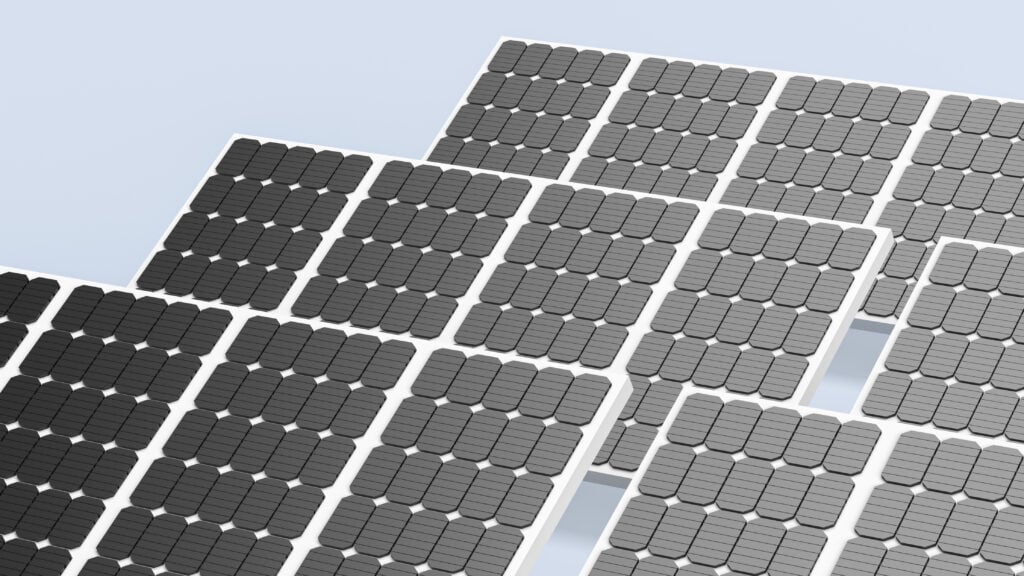
The visual difference is reliable enough to be useful. Monocrystalline cells look uniform black (sometimes very dark blue) with noticeably rounded corners — the rounding is a byproduct of cutting square cells from a cylindrical crystal ingot. Polycrystalline cells are blue with a speckled, marbled pattern, the visual signature of many crystal fragments fused together.
That said, treat color as a strong heuristic, not a guarantee. Anti-reflective coatings and all-black poly panels can blur the distinction. If it matters, read the datasheet rather than trusting the color alone.
Heat Is the Spec-Sheet Omission That Actually Matters
Efficiency figures on a datasheet are measured under Standard Test Conditions — a controlled lab environment that does not reflect your roof in July. In real operating conditions, panels get hot, and hot panels produce less power. Both mono and poly lose roughly 0.3–0.5% of output for every degree Celsius above the test reference point. Mono generally has a slightly better (lower-magnitude) temperature coefficient than poly, so it holds up marginally better in heat — treat that as a directional tendency rather than a fixed, guaranteed gap, since the exact coefficient varies by specific panel model.
Thin-film panels (more on those shortly) fare better in heat, with a coefficient around -0.2%/°C — roughly half the crystalline penalty.
The practical upshot most people miss: a blazing midsummer afternoon can produce less per rated watt than a cold, clear winter day. The sun is intense, but the panel is cooking. In hot climates, that temperature coefficient matters more than the efficiency gap between mono and poly. It’s the number that doesn’t fit on the marketing banner.
Light-Induced Degradation: The Loss That Starts Before Year One
Here’s the degradation fact that genuinely surprises people: crystalline silicon panels lose roughly 1–3% of their output in the first hours and weeks of sun exposure, through a process called Light-Induced Degradation (LID). The silicon’s crystalline structure stabilizes under early light exposure in a way that slightly reduces electron mobility. This happens before the steady long-term decline even begins.
So the output you see on day one is already below the rated sticker figure, and then the gradual annual decline — roughly 0.3–0.8% per year — compounds from there. Panels carry warranties of 25–30 years and typically produce usefully for at least that long. Claims of 40+ years exist, but no independent tester can verify multi-decade lifespan within any real test window — those figures are extrapolations from manufacturer projections, not measured outcomes. The 25–30 year warranty is the honest planning horizon.
None of this makes solar a bad investment. It does mean the output curve looks like a small cliff followed by a long gentle slope, and the day-one number you see on the spec sheet is the ceiling you’ll never quite reach.
Why Mono Costs More — and When That Cost Is Worth It
Growing a single pure silicon crystal is genuinely expensive. The process requires precise temperature control over a long growth cycle, and when you cut square cells from the resulting cylindrical ingot, you lose a substantial fraction of the silicon — sources cite figures around 50% yield loss from the squaring process alone. That waste is baked into the per-panel cost.
Polycrystalline panels use a simpler casting process that tolerates more variation in the silicon and wastes less material. The lower manufacturing complexity translates directly into lower panel cost.
The important reframe: what matters is cost per watt, not cost per panel. On a space-constrained roof where you can only physically fit a limited number of panels, mono’s higher efficiency can offset its higher panel price — you reach your target system size with fewer panels, less mounting hardware, and less installation labor. On a generous roof with room to spare, the cost case for paying the mono premium weakens considerably. Run the numbers for your specific roof and target system size, not the general rule.
Thin-Film: Better in Heat, Worse on Space
Crystalline silicon — mono or poly — dominates residential installations for a reason: it delivers the highest efficiency of common panel technologies. Thin-film panels (CIGS, CdTe, amorphous silicon) run lower. Based on figures from a single source, rough indicative ranges are: CIGS roughly 13–15%, CdTe roughly 9–11%, and amorphous silicon roughly 6–8%. Treat those as directional, not certified — they’re from one marketer and unconfirmed by a second source.
What thin-film does offer is a better temperature coefficient (around -0.2%/°C) and, in some formulations, flexibility. In high-heat environments or diffuse-light conditions, that thermal advantage can partially close the efficiency gap with crystalline. The hidden cost is footprint: lower efficiency means significantly more surface area for the same kilowatt output — a real constraint on residential roofs that the per-panel efficiency number alone doesn’t reveal.
PERC Technology: A Real Gain, but Read the Number Carefully
PERC stands for Passivated Emitter and Rear Cell — a rear passivation layer that allows the cell to capture light that would otherwise pass through and be lost as heat. It’s a real efficiency improvement, and it’s increasingly standard on mono panels.
How much improvement is contested. One manufacturer-affiliated source claims roughly 1% absolute efficiency gain. Another claims 5% extra. Those figures are irreconcilable without knowing whether each is measuring absolute efficiency percentage points or a relative percentage-of-percentage gain — and neither source defines its terms. The 1% absolute figure aligns with what independent technical literature suggests is plausible for a rear-passivation improvement. The 5% figure is an outlier from a solar marketer and should be treated with skepticism. When a seller’s own numbers can’t agree, the only honest position is: PERC is better, the exact magnitude is uncertain, and the 5% claim is unverified.
The Decision That Actually Matters
If your roof has abundant space and your budget is the constraint, polycrystalline panels offer good value — the efficiency gap costs you area, not energy per rated watt, and the per-panel savings can be real. If your roof is tight and you need to fit maximum output into limited space, mono’s efficiency premium earns its price. In either case, the spec to look at alongside efficiency is the temperature coefficient — especially if you’re in a hot climate — because that’s where the real-world gap between panel types opens up beyond what the headline numbers show.
The mono-is-better shorthand isn’t false. It’s just incomplete in the ways that cost people money. Same wattage, same power. Everything else is roof math and climate math — run both before you decide.